Loading....
Close


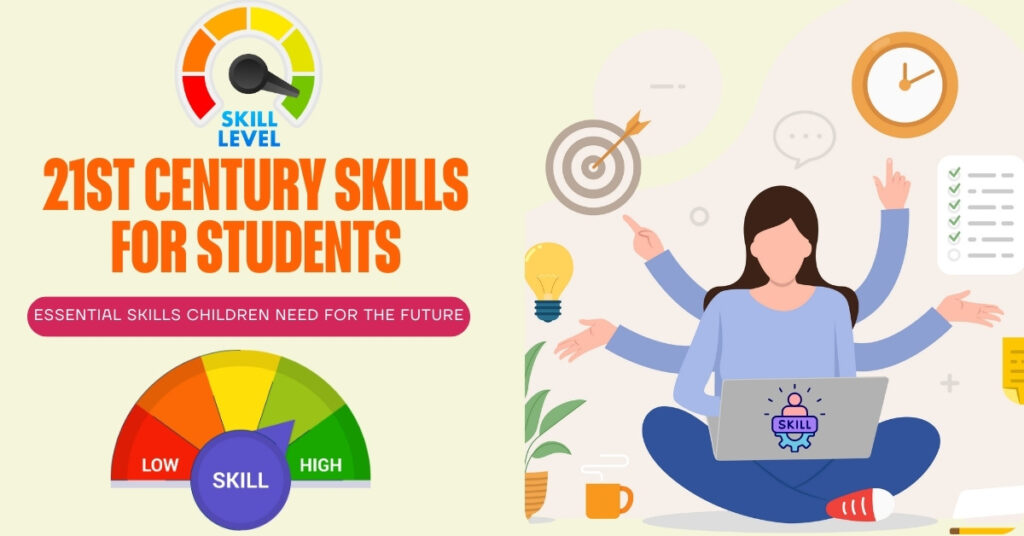
Bookish knowledge is no longer enough to survive, succeed, and thrive in this world. The future won’t reward children for memorising answers. It will reward them for asking better questions, adapting faster, and working well with others.
Thus, 21st-century skills for students are far more important than you think. They will help children thrive in modern classrooms and an ever-changing world beyond school.
This blog breaks down the most important 21st-century skills for students and how schools and parents can help develop them effectively!
There are two primary reasons why future skills for students are non-negotiable in today’s education system. One is rapid technological change (AI, big data, automation), and the other is complex global challenges (climate, public health, shifting economies).
Children are no longer just preparing for one career in a conventional manner.
That’s because employers and global reports consistently rank critical thinking skills, problem-solving, creativity, digital literacy, and adaptability among the top skills needed for the near future.
Thus, when schools and parents collaborate to build these skills early, it gives students a lifelong advantage!
Also Read: The Role of Education in Skill Development for Success
Let’s read about these 21st-century education skills in detail below:
Analytical and critical thinking skills for children help them evaluate information, question assumptions, and make informed decisions. Instead of memorising answers, students learn why something works and how different ideas connect.
Thus, these 21st-century skills and education compel students to interpret data, compare viewpoints, and think independently. This is a foundation for academic success and responsible decision-making in everyday life!
Problem-solving skills in education teach students how to approach challenges logically and creatively.
It can be tackling a math problem or navigating a real-life situation, but children must learn to identify issues, explore solutions, and evaluate the outcomes by themselves.
When problem-solving is embedded into school education, students gradually develop confidence, resilience, and the ability to handle unfamiliar situations without the fear of failure!
Strong communication and collaboration skills enable students to express their ideas clearly, listen actively, and work effectively with others. In modern classrooms, learning is increasingly team-based.
That’s why collaborative skills are essential!
They help children build empathy, resolve conflicts, and contribute meaningfully to group goals. This ultimately prepares them for leadership roles and collaborative work environments in the future!
Also Read: Leadership Skills for Students: 10 Qualities That Make Great Student Leaders
Creativity and innovation in education encourage students to think beyond conventional solutions. They learn to think originally and adapt better when they explore ideas freely, experiment, and learn from mistakes.
Moreover, creative learning environments help students become innovators! They become capable of imagining possibilities, improving existing ideas, and responding flexibly to change.
Digital literacy for students goes beyond using technology. It actually involves understanding, evaluating, and responsibly interacting with digital content.
Thus, students learn how to identify credible information, use digital tools effectively, and practice online safety. These 21st-century skills for education are essential for academic research, communication, and navigating the digital world with confidence and awareness!
Also Read: What Is the Role of the Computer in Education?
Self-management and adaptability are essential future skills for students that teach them to take ownership of their learning and respond positively to change.
These skills include setting goals, time management, emotional regulation, and resilience. They gradually turn into confident learners. This makes them capable of adjusting to new environments, overcoming challenges, and embracing lifelong learning!
Also Read: 15 Essential Life Skills for Teenagers
The above-mentioned 21st-century education skills can be easily and effectively taught in the following ways:
21st-century skills for education can and must be taught at home as well. Here’s how:
Also Read: Learning Styles of Students: Types, Examples & Parent Tips
21st-century skills for students are in no way replacing books. Instead, they add to bookish knowledge by teaching critical thinking, creativity, communication, collaboration, and digital literacy.
That’s because education is not just about scoring well. It’s also about preparing students to ask better questions, test ideas bravely and act with empathy and civic sense. This leads children to grow up into adaptable problem-solvers who are ready for unpredictable futures!
Also Read: Understanding Value-Based Education: Meaning, Importance & Benefits
At JBM Global School, education goes beyond textbooks. The learning environment is designed to encourage, nurture, and support! This teaches students to think critically, collaborate confidently, and grow into future-ready individuals. Enrol now to help your child become a confident, future-ready learner.
Ans: Schools should definitely start early! Even kindergarteners can practice collaboration, curiosity, and basic problem-solving with the help of play-based projects. That’s because skill development builds over years, not overnight.
Ans: Absolutely not! Instead, such lessons (for example, science projects that require research and communication) strengthen skills as well as knowledge.
Ans: Not exactly. Digital literacy includes safe, effective use of technology, understanding digital footprints and basic data sense. Thus, coding is a valuable subset that builds computational thinking.
Ans: Parents must look for the right signs: can they explain their thinking, collaborate without dominating, revise after feedback, evaluate information sources, or take on new learning independently?
Ans: Universities and employers increasingly view 21st-century skills for students as essential! Global reports and employer surveys rank critical thinking, creativity, collaboration and digital fluency among the top future skills. That’s why investing in these competencies makes students more adaptable and employable.