Loading....
Close


The first major academic decision in a student’s life is learning how to choose a stream after Class 10. This is when they are met with countless opinions from family, friends, teachers, and even social media.
Of course, every suggestion may come from a place of good intention. However, the final decision should be based on what is best for the student’s interests, abilities, and long-term aspirations.
That’s why a parent should sit with the student to evaluate all the options. This blog offers a comprehensive framework for understanding how to choose a stream after Class 10.
If you’re wondering which stream to choose after 10th, the most common answer ends up being the combination subjects where I scored the highest.
Your academic performance plays a signi, sure. But it cannot be the only deciding factor. A well-informed decision also takes the following factors into account:
Every student learns differently, and what works well for one individual may not be suitable for another. But a student often makes the mistake with stream selection for Class 11 by choosing the one that their friends are interested in or one that society deems best.
This can be easily countered with a simple aptitude test to identify their natural strengths across different domains such as numerical ability, analytical reasoning, verbal communication, creativity, spatial intelligence, and problem-solving.
Mind you, these assessments are not exams that students pass or fail. Instead, they are scientific methods to discover preferences and potential career fit.
For example, a student who consistently demonstrates strong logical reasoning and enjoys mathematics may naturally perform well in quantitative fields. On the other hand, a student who excels in communication, critical thinking, and social sciences may be better suited for careers involving people, policy, education, media, or law.
Many students say they want to become an engineer, doctor, entrepreneur, or IAS officer without fully understanding what these careers require. That’s why, instead of focusing immediately on job titles, students should first identify activities they genuinely enjoy.
A useful exercise is to reflect on favourite school subjects, extracurricular activities, hobbies, and the kinds of problems the student enjoys solving. Someone who spends hours building models, coding, or experimenting with technology may naturally gravitate towards scientific fields.
Another student who enjoys debates, writing, analysing human behaviour, or participating in theatre may discover a stronger connection with Humanities. Similarly, students who enjoy managing events, understanding businesses, calculating profits, or studying financial trends often find Commerce engaging.
Thus, stream selection based on interest can lead to better motivation, consistent performance, and deeper expertise.
The third factor is future aspirations. Of course, students are not expected to have their entire career planned at the age of fifteen or sixteen. However, there are usually many areas they feel curious about.
It’s important to connect these interests with possible careers to choose the best stream after 10th for a child. A parent can be supportive and useful during this decision-making process if they create a safe space for discussion.
The purpose is to better understand the student’s strengths and not to restrict their future possibilities. Parents should also refrain from comparing their child with relatives or neighbours. Instead, they can ask encouraging questions to understand their child better.
Also Read: Which Stream Is Best After 10th Class in India?
Science is great for students who have a strong interest in subjects like Mathematics, Physics, Chemistry, or Biology. If you enjoy experiments, analysing data, solving numerical problems, or understanding scientific concepts, this stream may be the right fit.
However, you should also be prepared for a curriculum that requires consistency, conceptual understanding, and regular practice.
The core subjects generally include Physics, Chemistry, and either Mathematics or Biology, along with English. Students may also study Computer Science, Informatics Practices, Psychology, Physical Education, or another elective. But this depends on the respective school and the chosen subject combination.
One of the first decisions Science students make is choosing between PCM vs PCB after 10th. Each combination leads to different academic and career pathways.
PCM (Physics, Chemistry and Mathematics) is recommended for students who are interested in engineering, architecture, computer science, artificial intelligence, robotics, aviation, defence services, and data science. It also provides a strong foundation for careers in analytics, finance, and technology.
On the other hand, PCB (Physics, Chemistry and Biology) is suitable for students who aspire to build careers in medicine and life sciences. It opens pathways to MBBS, BDS, BAMS, BHMS, veterinary science, nursing, pharmacy, physiotherapy, biotechnology, microbiology, genetics, and several allied healthcare professions.
Some schools offer PCMB, which includes both Mathematics and Biology. Although the workload is more demanding, this combination clears the confusion between PCM vs PCB after 10th and keeps both engineering and medical career options open for students who are yet to finalise their career goals.
The Science stream is no longer limited to engineering and medicine. The rapid advancement of technology has created opportunities that did not exist a few years ago.
Today’s students can pursue careers in artificial intelligence, cybersecurity, renewable energy, environmental science, biotechnology, forensic science, space research, nanotechnology, and many other fast-growing fields. Thus, a science career after 10th in India is one of the most versatile fields.
The expected salary range for a career after 10th in India if you choose Science depends on your domain, qualifications, skills, and experience. Fresh engineering graduates usually earn between ₹4 lakh and ₹10 lakh per annum, while graduates from premier institutions or specialised technology roles may receive higher packages.
Medical professionals actually spend more years in higher education before entering practice, but experienced doctors and specialists often earn significantly higher salaries. Careers in AI, data science, and cybersecurity are also among the fastest-growing and highest-paying professions today.
Also Read: Best Career Options After 12th Science in India: Top Courses, Salary & Career Growth
Commerce is going to be thriving for students who enjoy working with numbers, analysing financial information, understanding market trends, and solving business-related problems.
It also suits students who are interested in leadership, management, entrepreneurship, and decision-making. Students with strong analytical skills, logical reasoning, communication abilities, and an interest in economics or business studies also excel in this stream.
The core subjects in Commerce often include Accountancy, Business Studies, Economics, and English. Students can also choose to study Mathematics, Informatics Practices, Entrepreneurship, Marketing, Physical Education, or Legal Studies in certain schools that offer these combinations.
Mathematics along with Commerce can open additional opportunities in fields such as economics, finance, data analytics, and actuarial science.
The commerce stream scope has expanded significantly over the years. Students can pursue professional courses such as Chartered Accountancy (CA), Company Secretary (CS), Cost and Management Accountancy (CMA), or degrees like B.Com, BBA, Economics, Finance, or Business Management.
Other promising career options include investment banking, financial analysis, wealth management, stock market research, human resource management, marketing, business consulting, operations management, fintech, digital marketing, entrepreneurship, and business analytics.
Fresh graduates in Commerce-related fields generally earn between ₹3 lakh and ₹8 lakh per annum.
On the other hand, professionals such as Chartered Accountants, investment bankers, financial analysts, management consultants, and experienced business managers often earn significantly higher packages as they gain expertise and industry experience.
Students who combine strong business knowledge with digital and analytical skills are particularly well-positioned in today’s job market when it comes to commerce stream scope.
Also Read: Best Career Options After 12th Commerce With High Salary – Courses, Jobs & Scope
If you enjoy reading, writing, researching, debating, analysing social issues, and understanding human behaviour, Humanities might just be perfect for you!
Students with strong communication skills, creativity, empathy, curiosity, and an interest in current affairs, literature, history, psychology, or social sciences often find this stream highly rewarding.
The subjects offered in Humanities vary across schools but commonly include History, Political Science, Geography, Psychology, Sociology, Economics, English, Fine Arts, Legal Studies, Physical Education, and other electives. Students have the flexibility to choose subject combinations based on their interests and future career plans.
Students can pursue careers in law, civil services, psychology, journalism, mass communication, public policy, international relations, education, social work, hospitality, event management, publishing, advertising, content creation, public relations, design, linguistics, archaeology, and urban planning.
One of the biggest humanities stream benefits is the flexibility it offers. Students develop transferable skills such as communication, research, critical thinking, creativity, leadership, and problem-solving, which are valued across industries.
The stream also provides opportunities to explore interdisciplinary careers by combining subjects from different domains.
Fresh graduates from Humanities-related fields generally earn between ₹3 lakh and ₹7 lakh per annum, depending on their profession and qualifications.
On the other hand, experienced lawyers, psychologists, policy consultants, media professionals, educators, and civil servants often enjoy rewarding careers with excellent long-term growth.
Success in this stream depends largely on expertise, continuous learning, and skill development.
Also Read: Best Career Options After 12th Arts Stream: Top Courses, Salary & Future Scope
The decision of choosing the best stream after 10th for a child is often influenced by opinions, comparisons, and misconceptions instead of facts. So, let’s separate myth from reality so parents and students can make a confident decision with the help of this science, commerce, and arts after 10th guide!
Many people believe that students with the highest marks should automatically choose Science. However, academic scores only reflect performance in examinations, not a student’s interests, aptitude, or career aspirations.
A student who is passionate about business may excel in Commerce, while another who enjoys writing, psychology, or history may build a successful career through Humanities. That’s why stream selection based on interest is always recommended.
This is one of the biggest misconceptions among parents and students. Today, the humanities stream benefits extend far beyond teaching and civil services.
Students can build rewarding careers in law, psychology, journalism, public policy, international relations, design, digital marketing, content strategy, social work, hospitality, event management, and many other industries.
The growing demand for professionals with communication, analytical, and critical thinking skills has made Humanities one of the most versatile streams.
Yes, Chartered Accountancy remains a popular career choice, but the commerce stream scope has expanded significantly over the years.
Commerce students can now pursue careers in investment banking, financial planning, entrepreneurship, business analytics, management consulting, marketing, economics, fintech, stock market research, and corporate leadership.
Many professionals build careers outside their original academic paths with the help of higher education, certifications, interdisciplinary programmes, and skill development.
Of course, the right stream selection for Class 11 makes the journey smoother. However, students continue to have opportunities to explore new fields throughout their academic and professional lives.
A career after 10th in India becomes increasingly easier if parents and their children just sit together to discuss the possibilities. The following framework can be used to guide your discussion:
The discussion should begin with simple questions like which school subjects they genuinely enjoy studying. It can also include the kind of projects and activities that excite them the most.
It’s important to understand whether they prefer solving mathematical problems, understanding human behaviour, analysing businesses, or expressing creative ideas. The answers to these usually reveal their actual interests and help in stream selection based on interest.
The discussion should then shift to academic abilities. Are they comfortable with numbers and logical reasoning? Do they enjoy scientific experiments? Are communication, creativity, writing, or critical thinking their strongest skills? Parents must focus on identifying consistent strengths instead of looking only at report card marks.
You can also explore careers that genuinely interest you before finalising which stream to choose after 10th. You should research what professionals in those careers do every day, the qualifications they require, and the skills needed to succeed.
Once you identify a few career options, it becomes easier to determine the most suitable academic pathway.
Some students enjoy practical experiments and analytical problem-solving, while others prefer discussions, research, case studies, presentations, or creative projects.
As soon as you understand how you learn best, you will be able to identify which stream to choose after 10th, where you are more likely to stay engaged and perform well.
If you are still unsure, it’s highly recommended to consult experienced academic and career counsellors. Scientific aptitude assessments, career counselling sessions, and one-on-one discussions can provide valuable clarity before making an important decision.
However, it’s essential to remember that professional guidance should support, not replace, the student’s own interests and aspirations.
Also Read: Best Career Options After 12th in India for Science, Commerce & Arts Students
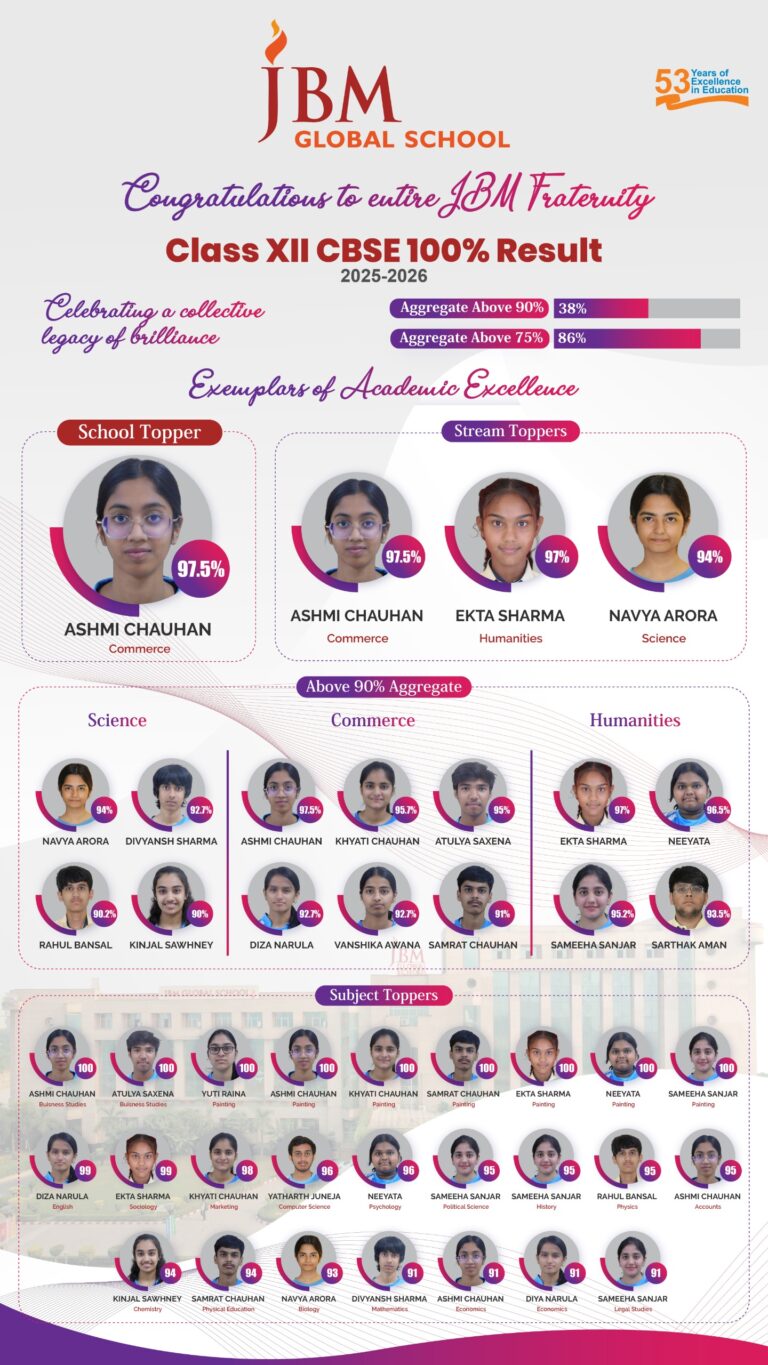
A career after 10th in India becomes increasingly easier when students have access to the right guidance and academic support. At JBM Global School, students can choose from Science, Commerce, and Humanities at the Senior Secondary level based on their interests and future goals.
Experienced career counsellors here help students understand their strengths, interests, and potential career pathways. The result includes informed decisions, better confidence, and a smoother academic journey.
JBM Global School also focuses on creating a learning environment that encourages critical thinking, practical learning, and overall personality development. This holistic approach helps students prepare not only for Class 11 stream selection but also for higher education and future career opportunities.
Also Read: How to Prepare for School Olympiad Exams: Complete Guide for Students
Thus, every stream offers exciting opportunities when it follows a student’s aptitude, interests, learning style, and career aspirations. That’s because the best stream is the one that fits your child the most. Science, Commerce, and Humanities each prepare students for meaningful and successful careers in today’s rapidly evolving world.
Hence, the best way to learn how to choose a stream after Class 10 is encouraging open conversations, exploring career options together, and seeking professional guidance whenever required.
Still unsure which stream to choose after 10th? At JBM Global School, our experienced academic counsellors help students and parents make informed decisions through personalised guidance, career awareness sessions, and subject selection support. Talk to JBM’s academic counsellors for stream guidance and take the first step towards a future that follows your child’s strengths, interests, and ambitions.
Ans: The best way to choose a stream after Class 10 is by evaluating your interests, aptitude, academic strengths, learning style, and career goals. Parents and students should make the decision together and seek professional counselling if needed.
Ans: There is no single “best” stream. Science, Commerce, and Humanities all offer excellent career opportunities. The right choice depends on your interests, abilities, and long-term aspirations.
Ans: Yes, of course! The right stream definitely provides a strong foundation. But many students pursue interdisciplinary courses, certifications, and higher education programmes that allow them to explore different career paths later.
Ans: Class 10 marks are definitely important, but they should not be the only deciding factor. A student’s aptitude, interests, motivation, and future goals should also be considered during stream selection for Class 11.
Ans: PCM vs PCB after 10th depends on your career goals. PCM is generally preferred for engineering, technology, architecture, and data-related careers, while PCB is suitable for medicine, healthcare, biotechnology, and life sciences.
Ans: Yes, sure. Commerce is an excellent stream for students interested in finance, business, economics, management, entrepreneurship, and accounting. The growing commerce stream scope offers numerous career opportunities across industries.
Ans: The primary humanities stream benefits include diverse career options, strong communication and analytical skills, and opportunities in law, psychology, media, civil services, public policy, education, and creative industries.
Ans: JBM Global School supports students with personalised academic counselling, career guidance programmes, subject selection assistance, and collaborative parent counselling.