Loading....
Close


Parents often search for the play group school age when their child reaches the toddler years. The question sounds simple, but the answer is not just a number. A child’s readiness, the school’s admission cut-off date, the length of the day, the teaching approach and the family’s routine all matter.
In India, many schools place playgroups around the 2-to-3-year age range, while some programmes accept children from about 18 months. There is no single age rule used by every preschool. Current admission pages show meaningful variation, so parents should check the specific school’s eligibility date before applying.
For example, Kidzee’s current Playgroup programme lists 2 to 3 years, while some other schools use an earlier starting point.
This guide explains the right age for playgroups, what children should ideally be ready for, what they actually learn, how to judge whether starting now is sensible, and what parents should look for when choosing a play school.
For many Indian preschools, the most common playgroup age is around 2 to 3 years. However, this should be treated as a common school-level practice, not a universal government-mandated age for every playgroup.
Current 2026 admission information from Podar Jumbo Kids lists Playgroup at 2 years completed by 1 June 2026 in several states, including Karnataka.
Similarly, Kidzee describes its Playgroup age group as 2 to 3 years.
Other programmes begin earlier. For example, SANFORT lists a toddler/playgroup option from 18 to 24 months, showing why parents should not assume one age band applies everywhere.
So, if you want a practical answer, 2 years to 3 years is a useful general reference point for playgroups in India. But the right starting age for an individual child may be earlier or later depending on readiness and the school’s admission policy.
If your child is around 2 years old and can manage a short period away from you, shows interest in other children, follows simple instructions and is beginning to communicate their needs, a playgroup may be worth considering.
There is also nothing inherently wrong with waiting. A child does not lose an important developmental opportunity simply because they begin preschool a few months later. The quality of the environment and the fit with the child matter more than racing to meet a particular admission date.
India’s National Curriculum Framework for Foundational Stage provides useful context. It recognises that children up to age 3 primarily grow and learn in the home environment, while organised preschool becomes increasingly relevant after age 3.
The Ministry of Education’s National Curriculum Framework for Foundational Stage stresses play, movement, conversation, music and responsive interaction as important forms of early learning.
That does not mean a two-year-old should not attend playgroup. It means parents should avoid treating early preschool as a race towards formal academics.
Not necessarily. A well-designed playgroup for two-year-olds should look very different from a primary classroom. Children at this age learn through movement, imitation, conversation, sensory experiences, songs, stories, pretend play and relationships.
The UNICEF India guidance on play explains that play supports exploration, decision-making, imagination, social skills and cognitive, motor and emotional development.
The key question is therefore not simply, “Is my child two?” It is, “What will my child experience for those few hours?” A warm, play-based environment can be developmentally appropriate. A programme built around long periods of sitting, copying and memorising is a very different proposition.
Parents should be cautious about schools that promise unusually advanced reading, writing or arithmetic at a very young age as the main measure of success. Early learning should build foundations rather than create unnecessary academic pressure.
Playgroup is usually a child’s first structured experience outside the home. It introduces routines and social experiences without expecting the child to behave like an older school student.
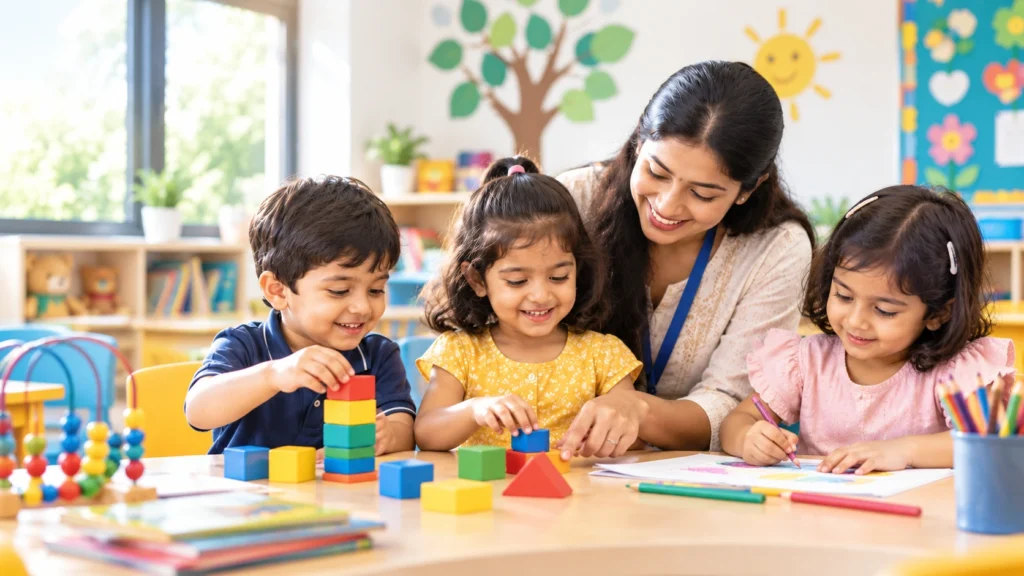
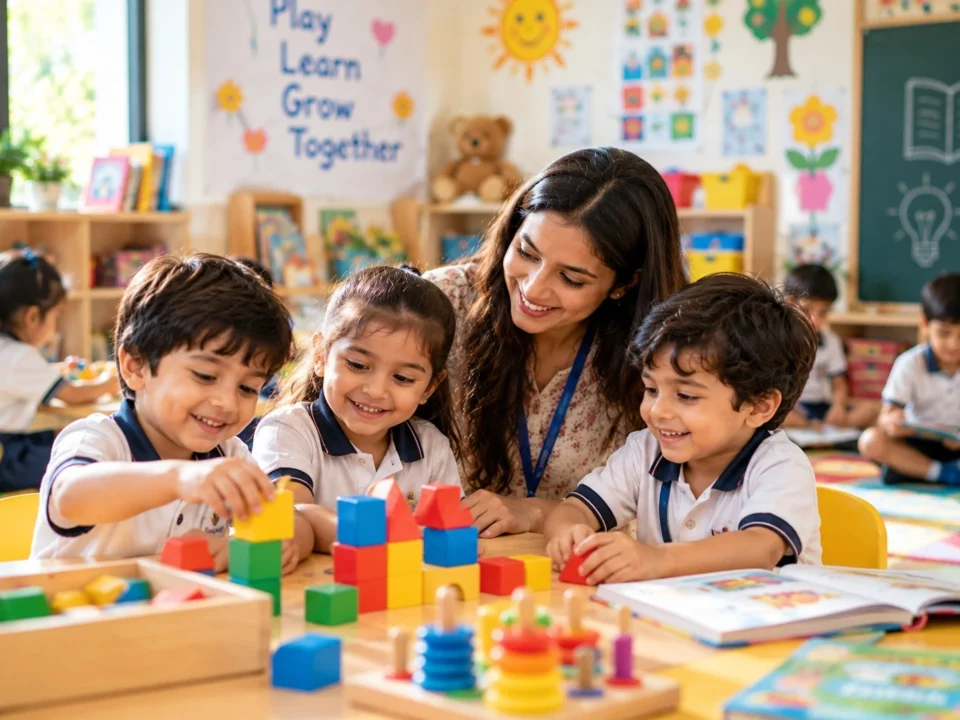
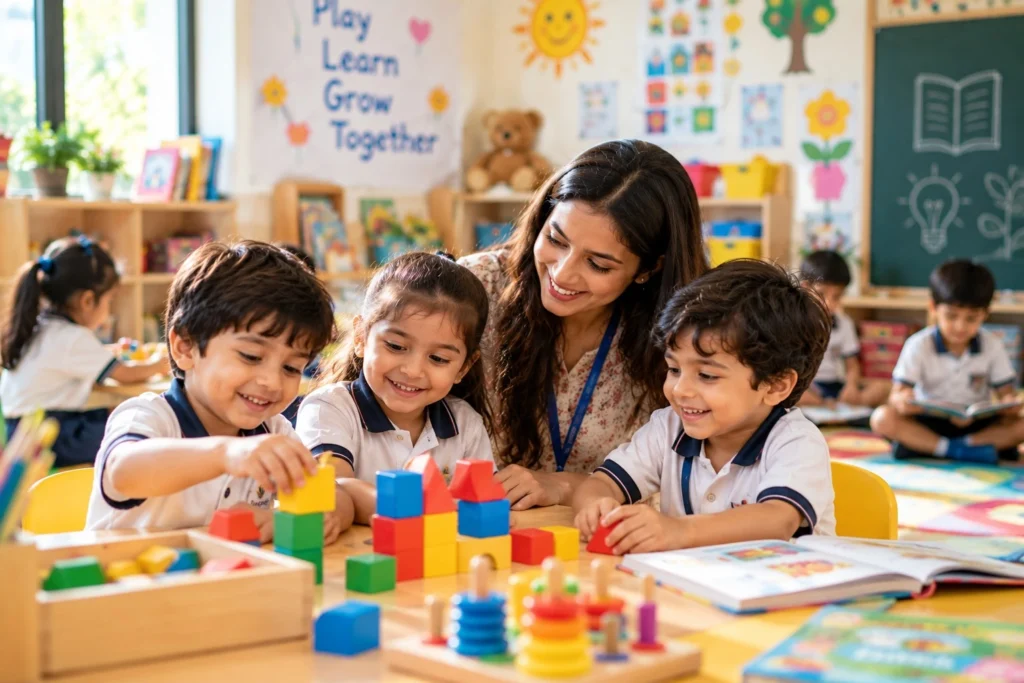
A typical playgroup may include free play, circle time, songs, rhymes, stories, movement, art, sensory activities, simple puzzles, outdoor play and basic classroom routines. The exact balance varies from school to school.
For example, Little Lambs Preschool describes its 2-to-3-year programme around play, language development, sensory exploration, fine and gross motor skills, social interaction and emotional wellbeing.
That is a useful way to think about the role of playgroup: it is not simply a smaller version of nursery. It is an early environment where children learn how to participate, communicate, explore and gradually become comfortable with a group setting.
| Stage | Common age range | Typical emphasis |
| Playgroup | About 2 to 3 years | Social adjustment, play, language, movement and routines |
| Nursery / Pre-Nursery | About 3 to 4 years | Language, early numeracy, independence and school readiness |
| Junior KG / LKG | About 4 to 5 years | Early literacy, numeracy, reasoning and structured activities |
| Senior KG / UKG | About 5 to 6 years | Greater independence and preparation for Grade 1 |
These are common patterns, not universal rules. Some schools call their first toddler programme Playgroup, while others use names such as Pre-Nursery, Toddler or Pre-KG. The name matters less than the age eligibility, learning approach and expectations.
Comfort with short separation: Your child can spend a short period with another trusted adult without becoming continuously distressed.
Basic communication: They can communicate needs through words, gestures, sounds or a combination of these.
Interest in other people: They notice other children, imitate adults or show curiosity about what others are doing.
Simple directions: They can respond to straightforward requests such as coming over, handing over an object or putting a toy away.
Growing independence: They show interest in feeding themselves, washing hands, putting away toys or attempting simple self-help tasks.
Curiosity and exploration: They naturally investigate objects, spaces, sounds, colours, textures and activities.
Some tolerance for routine: They can participate in a short activity and gradually adjust to simple routines.
None of these signs needs to be perfect before starting. Preschool is itself a place where children develop independence, communication and social confidence. The checklist is a guide to fit, not a test that labels a child ready or unready.
Crying at separation is common, particularly during the first days or weeks. A child can be ready for preschool and still feel upset when a parent leaves. The unfamiliar room, adults, sounds and routines can all feel like a lot at once.
UNICEF India’s early childhood parenting guidance encourages routines, talking, listening, play and supportive transitions for young children.
A good school should have a calm transition process rather than treating tears as bad behaviour. Teachers can acknowledge the child’s feelings, maintain a predictable routine and help the child become engaged in an activity.
Parents can help by keeping goodbyes short and reassuring. Sneaking away can sometimes make separation harder because the child becomes less confident that the parent will return. Agree a consistent routine with the teacher and give the child time to adjust.
Some schools accept children from 18 months, but that does not mean every 18-month-old needs playgroup. At this age, the quality of the setting and the length of separation become especially important.
For example, SANFORT’s current admission information lists an 18 to 24-month toddler programme, while other mainstream Playgroup programmes begin at two years.
For a child under two, parents should look for a very gentle environment with close adult supervision, movement, sensory play, communication and predictable routines. A short session can be more appropriate than a long school day.
If your child is thriving at home, enjoys regular interaction with family members and has plenty of opportunities for play and conversation, there is no need to enrol purely because other toddlers have started school.
The best playgroup syllabus is broad and age-appropriate. At two, learning is less about completing worksheets and more about developing the foundations that make later learning easier.
Language and communication: Stories, songs, conversation, picture books, naming objects and opportunities to express needs and ideas.
Social development: Learning to play near others, take turns with support, join group activities and begin understanding simple social expectations.
Fine motor development: Stacking, threading, scribbling, tearing paper, puzzles, playdough and other activities that strengthen hand control.
Gross motor development: Running, climbing, balancing, jumping, dancing and outdoor movement.
Cognitive development: Sorting, matching, noticing patterns, exploring cause and effect and solving simple problems.
Sensory exploration: Water, sand, textures, sound, colour, safe natural materials and hands-on exploration.
Self-help skills: Hand washing, putting toys away, carrying a bag, eating independently and gradually managing simple routines.
Emotional development: Naming feelings, seeking comfort, building trust with familiar adults and learning that school is a safe place.
This approach is consistent with UNICEF India’s play-based guidance for the Foundational Stage which recommends sensory exploration, stories, songs, role-play, movement, art and play-based early literacy and number experiences.
Play is not a break from learning in the early years. It is one of the main ways young children make sense of the world.
According to UNICEF India’s science of play guidance play gives children opportunities to explore their environment, make decisions, develop relationships, use imagination and build social, cognitive, motor and emotional skills.
Imagine a child playing shop. They may be practising language while pretending to speak to a customer, counting while handling objects, taking turns with another child and solving small problems when the game changes.
That is why a good playgroup can look surprisingly simple from the outside. A teacher may appear to be “just playing”, but the activity can have a clear developmental purpose.
School readiness should not be reduced to knowing the alphabet or writing one’s name. It includes the child’s ability to participate, communicate, manage simple routines, interact with others and approach new experiences with growing confidence.
UNICEF India describes early childhood education as important for school readiness and the foundation for lifelong learning.
The same source explains that India’s NEP 2020 places Early Childhood Care and Education from age 3 within the broader Foundational Stage, which continues through the early primary years.
This makes the transition from home to preschool particularly important. Children need schools that are ready for young children, not just children who are already ready for school.
India’s National Curriculum Framework for Foundational Stage provides useful context when parents think about early learning. It describes the Foundational Stage as covering ages 3 to 8 and places strong emphasis on play, activity, discovery and interaction.
The National Curriculum Framework for Foundational Stage notes that more structured learning becomes more appropriate as children develop, while younger children benefit from responsive care, play, movement, conversation and exploration.
This is important when evaluating the right age for playgroup. A school should not simply move formal primary-school practices into a toddler classroom. The environment needs to match how young children actually learn.
There is no single ideal duration for every child. Many Indian playgroups operate for around two to three hours, although schedules vary by school.
For example, Kidzee lists a three-hour Playgroup duration, while some smaller programmes use shorter sessions.
For a child who is new to group settings, a shorter session may feel easier at first. Some children adapt quickly; others need more time. Parents should ask whether the school offers a gradual settling-in period or flexibility during the first few days.
The quality of the time matters more than squeezing in as many activities as possible. A young child should have opportunities to move, explore, pause, talk and rest rather than being moved rapidly from one adult-directed task to another.
Early exposure to books, sounds, songs, mark-making and language is valuable. However, there is a major difference between introducing literacy playfully and expecting a two-year-old to complete formal handwriting or reading work.
At this age, picture books, storytelling, rhymes, conversations, drawing, scribbling, matching sounds and talking about pictures can build strong foundations.
The same principle applies to numbers. Counting everyday objects, sorting toys, comparing sizes and noticing shapes can be meaningful mathematical experiences without turning playgroup into a worksheet-heavy classroom.
UNICEF India’s teacher guidance for the Foundational Stage recommends early reading and number sense through play and cautions against rote memorisation.
None of these points alone proves that a school is unsuitable. The important question is balance. A young child can enjoy simple structured activities, but those activities should sit within a wider environment of play, movement, conversation and exploration.
Warm and responsive adults: Teachers should notice children’s cues, comfort them when needed and communicate respectfully.
Safe physical environment: Furniture, toys, gates, bathrooms and outdoor spaces should be designed with young children in mind.
Age-appropriate group size: Ask how many children are in the room and how many adults supervise them.
Play-based learning: Look for hands-on experiences rather than a classroom dominated by worksheets.
Outdoor movement: Young children need regular opportunities to move, not just indoor table activities.
Language-rich interaction: Teachers should talk with children, read stories, sing and encourage children to express themselves.
Clear parent communication: The school should explain routines, settling-in arrangements, meals, toileting, illness and daily updates.
Child protection and safeguarding: Ask how visitors, pick-up, emergencies and staff supervision are managed.
Individual attention: Children develop at different rates, so teachers should observe and respond rather than compare.
A school visit can tell you more than a brochure. Take this checklist with you:
Starting earlier is not automatically better. The benefits of early childhood education depend greatly on quality, relationships, developmental appropriateness and consistency.
The India Early Childhood Education Impact Study followed 14,000 four-year-olds in rural areas of Assam, Rajasthan and Telangana and examined preschool participation, school readiness, classroom quality and early-grade outcomes.
The study is useful because it shifts the conversation away from a simple race to enrolment. What matters is whether children experience a quality early learning environment that supports development and school readiness.
For parents, this means choosing the earliest possible admission date should not be the goal. The goal is to find the earliest point at which the child and the setting are a good fit.
Separation anxiety can be strong in the toddler years. It is a normal part of development for many children, particularly when a familiar parent leaves.
A predictable routine can help. Visit the school before the first day, talk about what will happen, practise short separations with trusted adults and use a consistent goodbye routine.
Parents should also avoid turning the first day into a long emotional negotiation. A calm goodbye, reassurance that you will return and a teacher who knows how to comfort the child can make the transition smoother.
There is no need to force the decision simply because your child has reached two. If a child becomes extremely distressed by separation, has little opportunity for rest, or is not comfortable with the proposed schedule, parents can consider waiting or choosing a gentler programme.
At the same time, do not assume that every tear means a child is not ready. Readiness can develop through a supported transition. Talk with the school about what they observe rather than making the decision from the first difficult morning alone.
| Child’s age | What to consider | Parent priority |
| 18–24 months | Some schools offer toddler/playgroup programmes | Very short, nurturing, sensory and relationship-focused setting |
| 2–3 years | Common Playgroup range | Play, language, social interaction, movement and simple routines |
| 3–4 years | Common Nursery range | Communication, independence, early literacy/numeracy and school readiness |
| 4–5 years | Common Junior KG/LKG range | More structured learning while retaining play and exploration |
| 5–6 years | Common Senior KG/UKG range | Greater independence and preparation for Grade 1 |
These ranges are a practical guide, not a universal admission rule. Always verify the school’s current cut-off date.
The first few weeks are about adjustment, not performance. A child may come home tired, become quieter than usual, or suddenly want extra closeness. These reactions can happen even when the child enjoys school.
Keep mornings predictable. Pack the bag together, follow the same departure routine and avoid rushing whenever possible. At home, allow extra time for rest and unstructured play. Young children are doing a lot of emotional work when they enter a new group.
It also helps to use simple, positive language. Instead of repeatedly asking whether your child was scared, ask what they played with, who they saw or what made them smile. This keeps the conversation open without making school feel like a test.
If difficulties continue, speak to the teacher early. A good teacher can often identify whether the issue is separation, tiredness, an unfamiliar routine, a particular activity or something else in the environment.
Starting a playgroup does not mean the school becomes responsible for all early learning. Home remains an important part of a young child’s development. Everyday conversations, shared books, pretend play, outdoor time and simple household tasks can reinforce what children experience at school.
Parents do not need expensive educational toys or a second classroom at home. Talking while cooking, sorting laundry by colour, counting steps, watering plants, looking at insects or making up a story together can provide rich learning opportunities.
UNICEF India’s guidance for parents emphasises talking, listening, playing, reading and involving young children in everyday activities. These small interactions can be more meaningful than filling a child’s free time with worksheets or educational apps.
The healthiest approach is to let school and home complement each other. If the school introduces a song, story, colour, shape or social routine, parents can revisit it naturally at home without turning every family moment into a lesson.
If you are still unsure whether your child should start, consider five questions. First, is the child reasonably comfortable with a trusted adult other than the parent? Second, does the school offer an age-appropriate programme rather than a compressed academic curriculum? Third, can the family manage the routine without creating excessive stress? Fourth, does the school have a clear and reassuring settling-in process? Finally, do the teachers appear to understand toddlers?
If most answers are yes, starting may be reasonable. If several answers are no, waiting or looking for a different programme may be the better decision. The aim is not to find the earliest possible admission date. It is to create a positive first experience of organised learning.
That first experience can shape how a child feels about school. A toddler who associates school with warm adults, interesting materials, movement, stories and successful little moments is building a very different foundation from a child who experiences constant pressure to perform.
For this reason, the best answer to the right age for playgroup is always a combination of age, readiness and environment. The calendar tells you when a child may be eligible. The child and the school together tell you whether the timing is actually right.
What is the usual play group school age in India?
Around 2 to 3 years is a common Playgroup range, although some schools accept children from about 18 months. The school’s admission policy and cut-off date should always be checked.
Can a 2-year-old start playgroup?
Yes, many schools offer Playgroups for children aged 2 to 3. Whether your child should start depends on their readiness, the programme and the family’s circumstances.
Is 18 months too young for a playgroup?
Not necessarily, but a programme for children under two should be especially gentle, closely supervised and focused on play, sensory exploration, movement and relationships.
What should a child know before joining playgroup?
They do not need to read or write. Basic communication, curiosity, some ability to follow simple routines and gradual comfort with trusted adults are more useful indicators.
What is the difference between playgroup and nursery?
Playgroup generally introduces children to group routines and social learning through play. Nursery usually builds on this with more intentional language, early numeracy, independence and school-readiness activities.
How long is a typical playgroup session?
Many programmes run for roughly two to three hours, but schedules vary. Ask the school about daily duration and whether it supports gradual settling in.
Does every school use the same playgroup age?
No. Admission ages and cut-off dates vary by school, state and programme structure.
Should I choose a playgroup with lots of worksheets?
For toddlers, a worksheet-heavy programme deserves careful questioning. Play, movement, conversation, stories, sensory exploration and hands-on activities should have a meaningful place in the day.
How can I help my child prepare for playgroup?
Practise short separations, establish predictable routines, read together, encourage simple self-help tasks, visit the school and talk positively about what will happen.
The play group school age is usually around 2 to 3 years in India, but the number on a school admission form should never be the only factor guiding the decision.
A child may be ready at two, need a few more months, or thrive in a very gentle toddler programme before moving into the more familiar Playgroup age range. There is no prize for starting earliest.
What matters is whether the child is entering an environment that respects how young children learn. At this age, play, movement, language, relationships, sensory exploration and everyday routines are not distractions from education. They are the foundation of it.
This approach is supported by UNICEF India’s early childhood education guidance and India’s National Curriculum Framework for Foundational Stage, both of which place strong emphasis on developmentally appropriate early learning.
So, when comparing schools, look beyond the admission age. Visit the classroom. Watch how teachers speak to children. Ask what happens when a child cries. Look at the balance between structured activities and free play. Understand the daily routine, safety arrangements and communication with parents.
The best playgroup is not the one that promises to make a toddler academically advanced overnight. It is the one that helps a young child feel safe, curious, capable and ready to discover the world a little more independently each day.