Loading....
Close


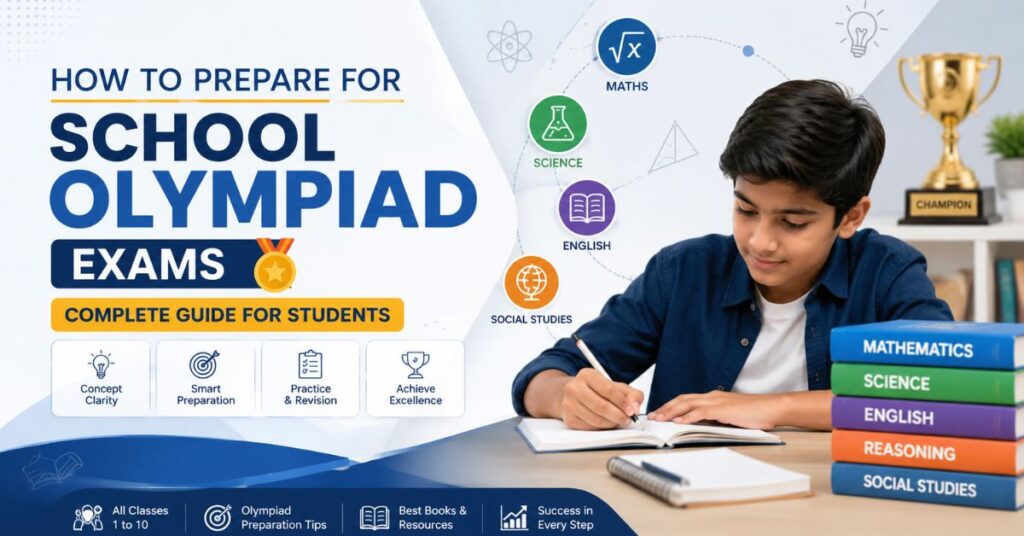
The current world is highly competitive. Hence, students are encouraged to develop strong analytical, logical, and problem-solving abilities from an early age. They can be mastered with school Olympiad exam preparation.
That’s because these exams go beyond textbook learning and compel students to apply concepts in practical and challenging situations. They also help in strengthening subject fundamentals and critical thinking skills that prove to be valuable in future competitive examinations such as JEE, NEET, CUET, and various scholarship tests.
This blog has put together a complete guide for students about the school Olympiad exam preparation. The good news is that with proper planning, consistent practice, and guidance from experienced teachers, students can perform exceptionally well.
Olympiad exams for school students are competitive assessments to evaluate their conceptual understanding, logical reasoning, analytical thinking, and application of academic knowledge.
Unlike regular school examinations that basically focus on textbook content, Olympiads test how effectively students can apply concepts to solve unfamiliar and challenging problems.
Most Olympiad exams for school students consist of multiple levels, where students qualifying in the first level become eligible for higher-level competitions. They are required to compete with students across the country and sometimes even internationally.
Several organisations conduct Olympiad exams for school students for different subjects. Each examination has its own syllabus, pattern, and eligibility criteria.
Maths Olympiad for classes 5 to 10 focuses on strengthening mathematical concepts, logical reasoning, data interpretation, and higher-order thinking skills.
The exam is conducted by the Science Olympiad Foundation (SOF). Students are tested on arithmetic, algebra, geometry, number systems, mensuration, statistics, and logical reasoning according to their respective class syllabi.
Science Olympiad preparation for students should include conceptual clarity instead of memorisation. The National Science Olympiad evaluates their understanding of Physics, Chemistry, Biology, Environmental Science, and Scientific Reasoning.
Questions are designed to assess their scientific thinking, analytical ability, and practical application of classroom concepts.
The IEO tests grammar, vocabulary, reading comprehension, communication skills, and language usage. Students with a strong hold in English fundamentals often perform exceptionally well by practising comprehension passages and vocabulary exercises regularly.
The ISSO examines students’ understanding of History, Geography, Civics, Economics, and current affairs. Instead of testing their memory, the exam focuses on conceptual understanding and analytical thinking.
NSTSE differs slightly from traditional Olympiads because it combines Science, Mathematics, Logical Reasoning, and Critical Thinking into one examination. The Olympiad benefits for students include interdisciplinary learning.
Also Read: 21st Century Skills for Students: Essential Future-Ready Skills Every Child Needs
Most Olympiad exams for school students are open to children studying from Class 1 onwards. But the eligibility depends on the organising body and the specific examination.
Students usually register through their schools if the institution is enrolled with the conducting organisation. Some organisations also provide individual registration options through their official portals.
If you’re wondering how to prepare for Olympiad exams, the syllabus is mostly based on the school curriculum. This allows the students to prepare alongside their regular academic studies without requiring entirely separate coursework.
The Olympiad registration process usually starts several months before the examination. This gives the students sufficient time for the school Olympiad exam preparation.
Schools affiliated with organisations such as SOF register interested students by submitting their details before the announced deadline. Students eventually receive admit cards, schedules, allotted venues, and instructions through their schools.
In cases where individual registrations are also permitted, parents can complete the application through the organiser’s official website on behalf of the student. They need to select the right examination, class level, and examination centre if required.
Also Read: Leadership Skills for Students: 10 Qualities That Make Great Student Leaders
Olympiad benefits for students can be fully experienced if you grasp how to prepare for Olympiad exams.
The students who build a strong conceptual foundation, practise regularly, and analyse their mistakes consistently tend to perform much better than those who just rely on rote learning.
Hence, the preparation strategy should focus on understanding the “why” behind every concept before attempting advanced questions.
Unlike regular mathematics examinations, IMO questions often involve multiple concepts in a single problem. That’s why analytical thinking is extremely important when you’re attempting the Maths Olympiad for classes 5 to 10.
For effective IMO SOF preparation, students should first master their NCERT or school curriculum before moving on to Olympiad-level questions. Topics such as Number System, Fractions, Decimals, Algebra, Geometry, Mensuration, Data Handling, and Arithmetic Operations should be thoroughly revised.
Mental calculations, logical reasoning exercises, and regular mock tests should become a part of the weekly study routine. Once the basics are clear, students should solve progressively challenging questions to improve speed and accuracy.
NSO preparation tips can come in handy because the National Science Olympiad demands both conceptual understanding and analytical ability.
Hence, your Science Olympiad preparation should begin by completing the entire school syllabus. Every chapter should be revised multiple times, and difficult concepts should be clarified with teachers instead of being skipped.
But don’t forget the Olympiad sample papers! Regular practice of previous years’ question papers makes you familiar with the exam pattern and helps you identify frequently tested concepts.
Since Logical Reasoning also forms an important section of the examination, students should dedicate a separate time each week to solving reasoning questions.
At the same time, they should improve their time management by practising full-length mock tests under actual examination conditions. It improves both speed and accuracy and reduces examination anxiety.
Students preparing for the English Olympiad should focus on developing strong grammar, vocabulary, comprehension, and language skills. Some habits that can prove to be helpful include reading newspapers, age-appropriate novels, magazines, and informative articles.
Daily grammar practice, learning new words with their meanings, solving comprehension passages, and writing short summaries also contribute significantly to overall language development.
Most importantly, instead of memorising grammar rules, students should understand how they are applied in different contexts.
Also Read: 10 Effective Study Habits Every Student Should Develop for Academic Success
The best Olympiad books for students make their preparation more organised and effective. But too many resources can be useless and overwhelming. Instead, students should focus on a few reliable study materials and complete them thoroughly.
School textbooks and NCERT books provide the conceptual foundation required for almost every Olympiad examination. Students who thoroughly understand these concepts usually find advanced Olympiad questions much easier to solve.
After completing the basics, students can move on to books specifically designed for Olympiad preparation. These books usually contain chapter-wise practice questions, higher-order thinking problems, previous years’ questions, and mock tests that closely follow the examination pattern.
Many educational platforms now offer interactive quizzes, video lessons, and online mock tests that make learning more engaging. These resources can enhance classroom learning and help students practise anytime, anywhere.
However, students should use them wisely and avoid relying on too many different platforms at once.
Olympiad sample papers help students understand the level of difficulty. They also familiarise students with the structure of the examination, the distribution of questions, and the marking scheme. This reduces surprises on the exam day and helps them approach each section with confidence.
Also Read: Robotics and STEM Education for Kids: Why It Matters and How Schools Are Teaching It
Every stage of schooling requires a slightly different preparation strategy. As students progress through higher classes, the level of conceptual understanding and analytical thinking expected in Olympiads also increases. Keep reading for a clearer understanding!
Students in the primary grades should focus on building curiosity and enjoying the learning process. At this stage, school Olympiad exam preparation should only involve understanding basic concepts, practising simple reasoning questions, improving observation skills, and developing confidence instead of chasing high scores.
Middle school students, on the other hand, can begin more structured preparation. They must grasp their Mathematics, Science, and English fundamentals. At the same time, they should solve introductory Olympiad practice questions and participate in regular mock tests.
At these grades, students should increase their practice of application-based questions. They should solve previous years’ papers, revise concepts systematically, and analyse mistakes after every mock test to improve their accuracy and speed during the Olympiad exams for school students.
Senior students should follow a disciplined study plan that balances school academics with Olympiad preparation. Since concepts become more advanced, regular revision, Olympiad sample papers, and mock tests become increasingly important.
Moreover, these exams lay a strong foundation for future competitive examinations such as JEE, NEET, CUET, and other national-level entrance tests.
JBM Global is one of the top schools in Noida that firmly believes in education beyond textbooks. Hence, the students are constantly given opportunities to experience holistic development.
Students are encouraged to participate in recognised Olympiad examinations as part of their academic curriculum. These competitions provide opportunities to challenge themselves beyond the classroom. They end up developing confidence, critical thinking, and problem-solving abilities.
The school’s learner-centric teaching approach focuses on conceptual understanding. At the same time, the classroom instruction, regular assessments, and interactive teaching methodologies help students develop the strong fundamentals required for successful Olympiad performance.
Teachers mentor students throughout their school Olympiad exam preparation by helping them strengthen concepts, improve analytical skills, and develop effective examination strategies. Thus, regular academic support ensures that students remain motivated and continue progressing at every stage of their Olympiad journey.
Also Read: How to Choose the Best School in Noida for Your Child
The school Olympiad exam preparation inspires students to think independently, solve complex problems, and develop a deeper understanding of subjects beyond the classroom curriculum. All you need to do is the right strategy, consistent practice, conceptual clarity, and the right guidance.
Regardless of the result, the journey itself helps students become more disciplined, curious, and confident learners. Moreover, starting early, practising regularly, and learning from every mock test can make the preparation process both enjoyable and rewarding.
Discover how JBM Global helps students excel in Olympiad examinations while ensuring holistic development. Get in touch with us today and give your child a bright future!
Ans: Students should begin school Olympiad exam preparation by thoroughly understanding their school syllabus before moving on to Olympiad-level practice questions. Consistent revision, mock tests, and concept-based learning form the foundation of effective preparation.
Ans: Some of the most recognised Olympiad examinations include the International Mathematics Olympiad (IMO), National Science Olympiad (NSO), International English Olympiad (IEO), International Social Studies Olympiad (ISSO), and National Level Science Talent Search Examination (NSTSE).
Ans: Students can start participating in Olympiads from the primary classes, but preparation should always be age-appropriate. It’s important to build strong fundamentals from an early stage to make advanced Olympiad preparation much easier in higher classes.
Ans: Yes, definitely! Olympiad sample papers help students understand the examination pattern, improve time management, identify weak areas, and gain confidence before the actual examination.
Ans: Students should first complete their school textbooks and NCERT books before using reputed Olympiad preparation books. These offer chapter-wise practice questions, mock tests, and previous years’ papers.
Ans: Olympiad benefits for students strengthen their conceptual understanding, improve logical reasoning, enhance problem-solving skills, build confidence, and prepare them for future competitive examinations. High-performing students may also receive certificates, medals, scholarships, and national or international recognition.