Loading....
Close


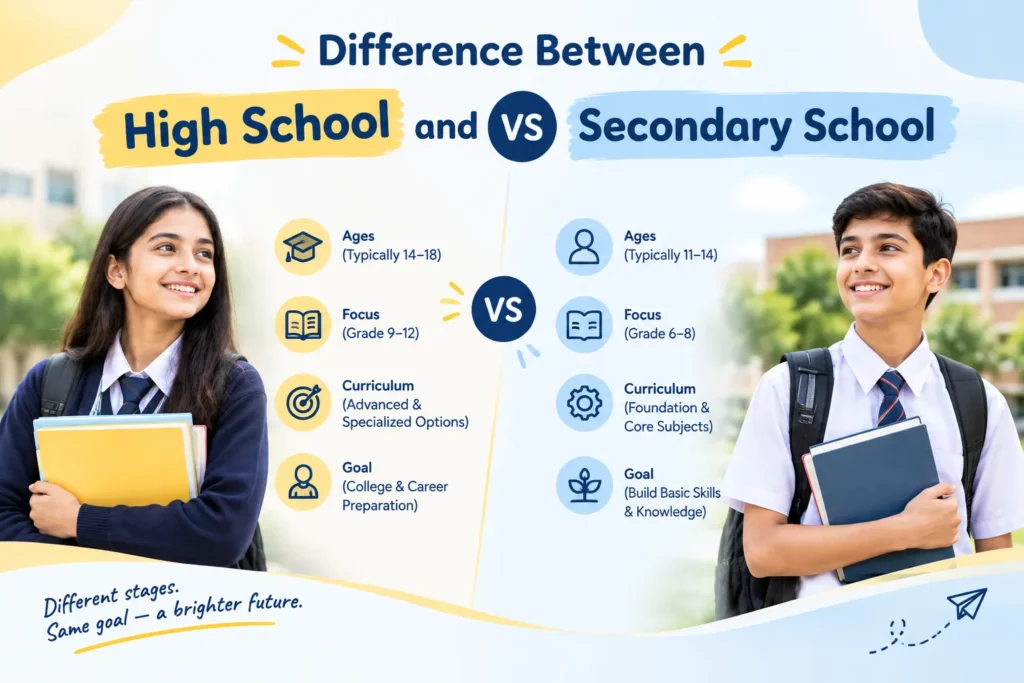
If you are searching for secondary school vs high school, the first thing to know is that the two terms do not always mean exactly the same thing in India. In common school usage, secondary school usually refers to Classes 9 and 10. High school is a broader, less standard label and may refer to Classes 9 to 12, or sometimes only the senior years of school.
The terminology becomes clearer when you add higher secondary or senior secondary to the conversation. In the conventional Indian structure, Classes 9 and 10 are secondary, while Classes 11 and 12 are higher secondary or senior secondary. However, the National Education Policy (NEP) 2020 uses the term Secondary Stage for all four years from Classes 9 to 12.
So, there is a useful distinction between everyday terminology and policy terminology. If a school website says secondary school, check the grades it actually offers. If it says high school, check whether it includes Classes 9 and 10, Classes 11 and 12, or the complete 9 to 12 journey.
Parents often encounter the words secondary, high school, senior secondary and higher secondary while comparing schools. The problem is that these labels are not used identically by every board, state, country or school.
A school may describe Classes 9 and 10 as secondary school and Classes 11 and 12 as senior secondary. Another school may call Classes 9 to 12 high school. A policy document can use a secondary stage to describe the entire four-year period. None of these labels should be interpreted in isolation.
The safest approach is simple: look at the grade range, board affiliation, examination structure and subjects offered. The name on the signboard matters less than what the school actually provides.
| Point of comparison | Secondary school | High school |
| Common Indian usage | Usually, Classes 9 and 10 | Often used broadly for Classes 9 to 12 |
| NEP 2020 terminology | Part of the Secondary Stage | Not the main NEP stage label |
| Typical age | Around 14 to 16 | Often around 14 to 18 when used for Classes 9 to 12 |
| Main purpose | Build deeper subject knowledge and prepare for Class 10 | Support secondary and senior school learning, exams and future pathways |
| Subject pattern | Broad set of core subjects | Broad in Classes 9 to 10, more specialised in Classes 11 to 12 |
| Major milestones | Class 10 assessment or board examination | Class 10 and Class 12 examinations, depending on board |
| Future focus | Build academic habits and explore interests | Subject choices, higher education and career preparation |
In everyday Indian school terminology, secondary school generally refers to Classes 9 and 10. These years follow the middle stage, usually Classes 6 to 8, and mark a clear increase in academic depth and responsibility.
Students encounter concepts that require more sustained reasoning, regular revision and stronger written expression. Mathematics becomes more demanding, science moves towards deeper conceptual understanding, and social science requires students to connect facts, causes, evidence and consequences.
Secondary school is also where study habits begin to have a much more visible effect on performance. Students who learn to plan their work, revise consistently and ask for help early are usually better prepared for the pressure that follows.
The CBSE Secondary Curriculum separates the Secondary Curriculum for Classes IX-X from the Senior Secondary Curriculum for Classes XI-XII.
Classes 9 and 10 are not simply more difficult versions of middle school. They are a transition towards greater independence. Students are expected to understand concepts, apply them to unfamiliar questions and take increasing responsibility for their own progress.
The current curriculum direction also places more emphasis on competencies rather than simple recall. The National Curriculum Framework for School Education 2023 describes Grades 9 and 10 as the first phase of the Secondary Stage and calls for breadth across curricular areas, conceptual learning and greater opportunities for analysis and inquiry.
For the policy framework, see the National Curriculum Framework for School Education 2023, particularly its section on the Secondary Stage.
High school is less precise as a formal Indian label. In many conversations, it means the senior years of school, often Classes 9 to 12. In other contexts, especially when a school distinguishes secondary and senior secondary, high school may be used for Classes 9 and 10.
This is why a direct answer to the question ‘Is high school the same as secondary school?’ is not always yes or no. The terms overlap, but they are not universally interchangeable.
If high school is being used broadly, it covers two distinct academic phases. Classes 9 and 10 build the secondary foundation. Classes 11 and 12 usually bring greater subject depth, more choice and preparation for higher education or employment pathways.
The clearest distinction in the Indian school system is often between secondary and senior secondary, rather than between secondary and high school.
| Stage | Classes | What changes |
| Secondary | 9 and 10 | Broader curriculum, deeper concepts, stronger study habits and preparation for Class 10 assessment |
| Senior secondary / higher secondary | 11 and 12 | Greater subject choice, specialisation, practical work and preparation for Class 12 and future pathways |
The distinction is also reflected in the Central Board of Secondary Education’s curriculum structure. CBSE lists a Secondary Curriculum for IX-X and a separate Senior Secondary Curriculum for XI-XII.
You can verify the current structure directly on the CBSE Academics curriculum page.
This is where the terminology changes significantly. NEP 2020 reorganises school education into a 5+3+3+4 structure covering ages 3 to 18. The Secondary Stage is the final four-year stage and covers Classes 9 to 12.
The policy divides this stage into two phases: Classes 9 and 10, followed by Classes 11 and 12. In other words, the policy uses ‘secondary stage’ more broadly than the conventional Indian use of ‘secondary school’ for Classes 9 and 10.
The policy also describes the Secondary Stage as multidisciplinary, with greater depth, critical thinking, attention to life aspirations and flexibility in subject choice. This matters because parents reading current education-policy material may see Classes 11 and 12 included under the word secondary.
The Ministry of Education’s NEP 2020 document provides the official 5+3+3+4 structure and defines the Secondary Stage as Classes 9 to 12.
Suppose a parent reads that the secondary stage covers ages 14 to 18 and assumes this means every school will call Classes 9 to 12 ‘secondary school’. That would be an over-simplification. Policy language and school naming conventions can differ.
For admissions, always follow the school’s published grade structure and the applicable board or state requirements. For understanding national education policy, use the NEP definition.
This small distinction prevents a surprisingly common mistake: treating ‘secondary school’ as a fixed label when it can mean different things in different contexts.
The curriculum is where the difference becomes practical for students. In Classes 9 and 10, the focus is generally on building breadth and depth across core areas. In Classes 11 and 12, students normally move towards greater specialisation, although the exact choices depend on the board and school.
Students typically continue with languages, mathematics, science and social science, along with additional academic, vocational, artistic or physical education opportunities depending on the curriculum. The aim is to build a strong base rather than force an early professional choice.
The National Curriculum Framework for School Education 2023 recommends a broad curriculum in Grades 9 and 10 and emphasises conceptual understanding, inquiry, discussion, analysis and competency development.
See the NCERT Grade 9 Secondary Stage syllabus guidance for the emphasis on conceptual depth and inquiry-based learning.
After Class 10, students generally have more choices. Depending on the board and school, options may include science, commerce, humanities, languages, computer-related subjects, design, vocational subjects and combinations that cross traditional stream boundaries.
Importantly, students should not assume that every school offers the same combinations. Even within the same board, the subjects available can differ by school because of staffing, facilities and school-level choices.
CBSE’s own student handbook has explained that the board does not require students to follow only the old Science, Commerce or Humanities combinations. Subject choice can be more flexible within the board’s permissible combinations.
For the official explanation of senior secondary subject choice, see the CBSE Handbook for Students.
No. That is one of the most important points in this guide. High school is a contextual term. In some schools it means Classes 9 to 12. In others, it may mean Classes 9 and 10. International school systems may use high school for a different grade range altogether.
Even dictionaries reflect this broad international usage. The term can refer to education after elementary or junior secondary school, with the exact grades varying by system.
For an international terminology reference, see the Dictionary.com comparison of secondary school and high school.
UNESCO uses a classification system designed to make education systems comparable across countries. In the International Standard Classification of Education, lower secondary and upper secondary are treated as distinct levels.
Lower secondary education generally builds on primary education and becomes more subject-focused. Upper secondary education provides more specialised and differentiated learning, often with a wider range of options and pathways.
UNESCO also notes that upper secondary programmes can be called secondary school, senior secondary school or senior high school in different systems. That is a useful reminder that the label itself does not establish the grade range.
See the UNESCO Institute for Statistics glossary and the ISCED 2011 classification for the international definitions of lower and upper secondary education.
Usually, but not always. Students in Classes 9 and 10 are commonly around 14 to 16 years old, while Classes 11 and 12 are commonly around 16 to 18. Individual ages can vary because of admission dates, school-entry age, transfers, gaps in education and different education systems.
The NEP 2020 framework associates the Secondary Stage, Classes 9 to 12, with ages 14 to 18. This is a policy framework rather than a guarantee that every student will fit that exact age range.
For admission decisions, use the school’s current age criteria and board rules rather than relying on a general age chart.
Board examinations are another reason parents should distinguish the stages carefully. In many Indian boards, Class 10 is a major secondary-level examination point. Class 12 is the senior secondary milestone and is often directly relevant to university admissions and entrance requirements.
CBSE’s terminology itself illustrates this separation. The board maintains separate curriculum structures for Secondary IX-X and Senior Secondary XI-XII, and its examination processes distinguish Class X and Class XII.
However, the exact assessment pattern can vary by board and year. Parents should therefore check the current official examination rules instead of relying on old advice or school marketing material.
For current notices and examination updates, consult the CBSE Examination Circulars where applicable.
The move from Class 10 to Class 11 is often more significant than the move from one school building to another. Students may encounter new subjects, new teachers, a faster pace and more independent study.
This does not mean students must have their entire careers decided at 15 or 16. A healthy approach is to use Classes 9 and 10 for exploration and Classes 11 and 12 for increasingly informed choices.
Subject choice in senior secondary school can affect which undergraduate courses and entrance pathways remain open. That is why the right question is not simply, ‘Which stream is best?’ The better question is, ‘Which subjects fit my child’s strengths, interests and likely future options?’
These are examples, not universal rules. University and entrance requirements can change, so students should verify the latest eligibility criteria for the courses they are considering.
If you are choosing a school for Class 9 onwards, do not make the decision based only on whether the school calls itself a secondary school or a high school. Evaluate the actual learning environment.
Grades: Confirm whether the campus offers Classes 9 to 12 or only a portion of that range.
Board: Confirm the exact board and the current curriculum followed at the campus.
Class 10: Ask how students are prepared for the Class 10 examination and how learning gaps are addressed.
Class 11: Ask which subject combinations are actually available, not merely advertised in general terms.
Class 12: Check the senior secondary examination and university-preparation support.
Teaching: Ask how the school balances conceptual understanding, practice, projects and assessment.
Wellbeing: Ask who students can approach when they are anxious, overwhelmed or struggling.
Activities: Check whether sports, arts, clubs, debate, technology or leadership are accessible to students.
Commute: Consider daily travel time, because long journeys can affect sleep, study and family time.
Communication: Ask how often parents receive meaningful academic and developmental feedback.
Class 9 is sometimes treated as a warm-up for Class 10. That is a mistake. It is the year in which students can build the habits that make the following year manageable.
A student does not need a perfect timetable. What matters is consistency: reading carefully, solving problems regularly, revising before assessments, reviewing mistakes and learning to manage deadlines.
Parents can help most by creating structure without turning every evening into an examination hall. Encouragement, realistic expectations and early communication with teachers are often more useful than last-minute pressure.
Class 11 can feel like a sudden jump. Students may move from a relatively common set of subjects to combinations that demand deeper understanding. A student who performed well in Class 10 may need time to adjust.
This is where schools can make a meaningful difference. Teachers should explain expectations clearly, identify gaps early and encourage students to seek help before they fall behind.
Parents should also avoid assuming that one poor test predicts a student’s future. The first few months can involve a genuine adjustment to pace, subject depth and workload.
Changing schools after Class 8, Class 10 or before Class 11 can sometimes be sensible. It may be necessary if the current school does not offer the desired board, grade range, subject combination or support.
But a school change also creates adjustment costs. Students have to adapt to new teachers, classmates, routines, assessment styles and expectations. If the change also involves a new board, there may be differences in subject sequencing and assessment.
Before changing schools, compare the complete academic pathway rather than the immediate attraction of a campus. A school that looks excellent for Class 9 should also make sense for Classes 10, 11 and 12 if continuity is important to your family.
The phrase high school does not identify a board. A high school can follow CBSE, ICSE, Cambridge, a state board or another recognised curriculum. Likewise, the term secondary school does not automatically tell you how a school teaches.
Board selection should therefore be based on curriculum fit, subject availability, assessment style, mobility needs, future education plans and the individual child’s learning preferences.
For example, CBSE currently publishes separate secondary and senior secondary curriculum structures. Cambridge uses its own terminology and qualification pathways. State boards may use terms such as high school, secondary school, higher secondary or junior college depending on the state.
There is no universally ‘best’ board for every student. The quality of teaching, support, curriculum fit and school culture matter enormously.
A strong school experience should prepare students for more than examinations. Academic results matter, but students also need communication, critical thinking, collaboration, digital literacy, resilience and the ability to make informed decisions.
The National Curriculum Framework for School Education 2023 places emphasis on critical thinking, inquiry, flexibility and breadth and depth in learning. It also moves away from the idea that students must be forced into rigid academic streams.
This is especially relevant today because students may eventually work in roles that do not exist in exactly the same form when they enter Class 9. Schools should therefore build transferable capabilities alongside subject knowledge.
Technology is now part of how students research, communicate, create and learn. That does not mean every lesson needs a screen. It means students should learn how to use digital tools responsibly and evaluate information critically.
The goal is not to make students dependent on technology. It is to make them capable of using technology thoughtfully while retaining the human skills of judgement, creativity and communication.
Secondary and high school students still need opportunities outside textbooks. Sport, music, theatre, art, debate, coding, clubs and community activities can help students develop confidence and discover interests that may not appear in examination results.
Co-curricular activities should not become another source of pressure. The useful question is whether students have meaningful opportunities to participate, practise, collaborate and lead.
A well-balanced school makes room for academic focus without treating every non-academic activity as a distraction.
Classes 9 to 12 coincide with major developmental changes. Students may become more sensitive to peer comparison, academic expectations and questions about identity and the future.
A supportive school does not lower standards. It combines high expectations with respectful relationships, clear feedback and appropriate support. Students should be able to make mistakes without being humiliated and ask for help without feeling that they have failed.
A school calling itself a high school does not tell you whether it includes Classes 9 to 12. Always verify the actual grade range.
If your child may remain in the same school, check senior secondary subjects before admission. A good Class 9 experience can become inconvenient if the school does not offer the subjects your child later needs.
Results are useful evidence, but they do not show how the school supports students who are average, anxious, creative, struggling or academically advanced. Ask how the school handles different learner needs.
Fees can reflect location, facilities, staffing and brand positioning. They do not automatically prove teaching quality. Observe classrooms, ask about teachers and understand what students actually experience.
Students should explore interests in Classes 9 and 10 rather than being pushed into a permanent identity at 14. By Classes 11 and 12, choices can become more informed through subject performance, interests and reliable career guidance.
Class 8: Strengthen reading, mathematics, writing, organisation and confidence. Start evaluating whether the current school can support the next stage.
Class 9: Build consistent study routines, understand concepts deeply, learn from mistakes and explore interests.
Class 10: Focus on strong conceptual understanding, examination skills, wellbeing and informed discussion about Class 11 choices.
Class 11: Adjust to greater subject depth, develop independence and connect subjects with possible higher education pathways.
Class 12: Balance board preparation with entrance requirements, university applications, career planning and a healthy transition beyond school.
If you need to explain the difference to a child, keep it simple. You can say: ‘Secondary school usually means Classes 9 and 10. High school is a broader term that may include Classes 9 to 12. Classes 11 and 12 are usually called senior secondary or higher secondary in India.’
That explanation is accurate enough for everyday use while leaving room for the terminology used by a particular school or education system.
Not always. In India, secondary school commonly refers to Classes 9 and 10, while high school is often used more broadly for Classes 9 to 12. The exact meaning depends on the school and education system.
In conventional Indian usage, Classes 9 and 10 are called secondary school. Under NEP 2020, however, the Secondary Stage covers Classes 9 to 12.
Class 10 is generally part of secondary school. It can also be described as high school when a school uses high school as a broad term for Classes 9 to 12.
In India, Class 12 is normally described as senior secondary or higher secondary. It may also be included under high school when that term covers Classes 9 to 12.
Secondary generally refers to Classes 9 and 10, while senior secondary generally refers to Classes 11 and 12. The latter usually involves greater subject specialisation and preparation for higher education or employment pathways.
Students are commonly around 14 to 16 in Classes 9 and 10, although individual ages vary. NEP 2020 places the broader Secondary Stage of Classes 9 to 12 at approximately ages 14 to 18.
No. Some schools use high school to describe only part of the senior years. Check the school’s published grade range before applying.
Yes. CBSE publishes a Secondary Curriculum for Classes IX-X and a Senior Secondary Curriculum for Classes XI-XII.
If continuity is important to your family, it can be beneficial. It reduces the need for a second admission process after Class 10, but you should still check whether the school offers the right subjects and support for Classes 11 and 12.
No. Grade ranges and terminology vary by country and education system. UNESCO uses internationally comparable classifications rather than relying on school labels alone.
The difference between high school and secondary school is less about two completely separate types of education and more about terminology. In conventional Indian usage, secondary school usually means Classes 9 and 10. Higher or senior secondary usually means Classes 11 and 12. High school is a broader term that may include Classes 9 to 12, depending on the school and context.
NEP 2020 adds another layer by defining the Secondary Stage as Classes 9 to 12. This is why parents can encounter apparently different definitions and still be reading accurate information.
For a real school decision, do not get stuck on the label. Check the board, grade range, curriculum, Class 11 subject choices, assessment pattern, teaching quality, student support, facilities and opportunities beyond academics.
The best secondary or high school is not simply the one with the strongest name or the longest list of facilities. It is the one that gives students strong academic foundations, teaches them to think independently and supports them as they move towards higher education, work and adult life.