Loading....
Close


The previous generations were part of an education system that has become obsolete now. That’s because education in India is ever-changing to keep up with the rest of the evolving world. With this thought in mind, the National Education Policy was introduced in 2020.
The focus immediately shifted from memorisation-based learning to skill development, creativity, flexibility, and holistic growth. It has been six years since then, yet many parents are still confused. Hence, it’s helpful to have NEP 2020 explained clearly in a blog.
Our country’s education system was too exam-oriented. But the National Education Policy 2020 replaced the older education policy of 1986 to make the system more practical, skill-oriented, flexible, inclusive, and futuristic.
Basically, this new framework was introduced by the Government of India to transform the country’s learning system from preschool to higher education. The new education policy in India focuses on preparing children for exams as well as for real life.
While the previous policy simply promoted rote learning, the new framework encourages:
Thus, the National Education Policy 2020 urges children to understand concepts deeply rather than blindly memorising them for marks alone.
India’s previous education system was not without its flaws. That’s why a new education policy in India was imminent and necessary. Some of the challenges faced by the previous policy include:
Thus, the result of meaningless memorisation led to incapacity and inefficiency. Students struggled and failed to thrive in the real world with the resources and skills they acquired from school.
However, NEP 2020 implementation addresses these concerns to build a system with global standards and future career demands. It recognises the fact that every child is unique, they learn differently, and need an environment that supports their curiosity, creativity, collaboration, and confidence.
Also Read: The Role of Education in Skill Development for Success
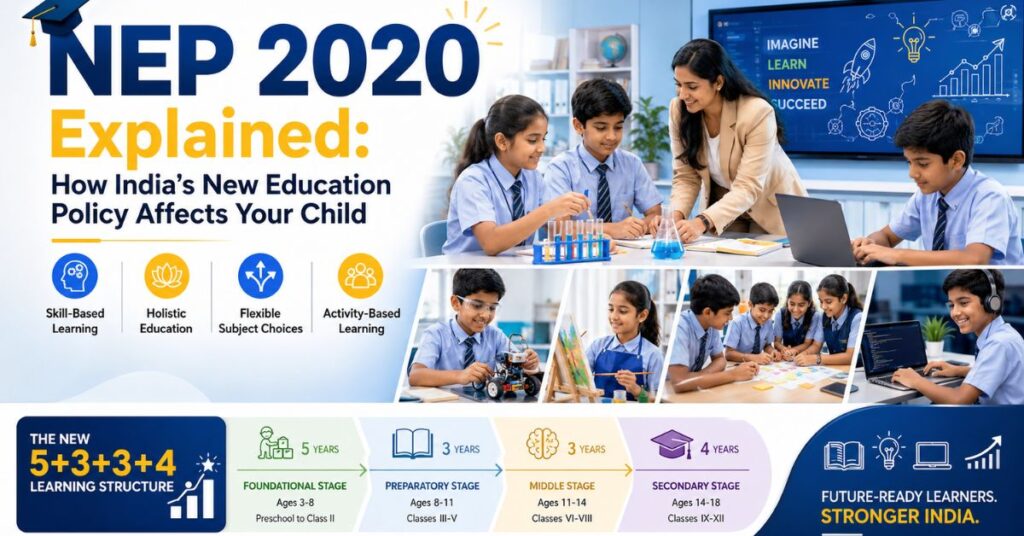
You are probably familiar with the 10+2 system in every school. But one of the most talked-about NEP 2020 changes is the introduction of the 5+3+3+4 structure. It includes the importance of early childhood education, which was previously quite neglected.
The following table offers a clear idea about the 5+3+3+4 structure:
| Stage | Age Group | Classes | Focus Area |
| Foundational Stage | 3-8 years | Preschool to Class II | Play-based & activity-based learning |
| Preparatory Stage | 8-11 years | Classes III-V | Discovering, interacting, & foundational literacy |
| Middle Stage | 11-14 years | Classes VI-VIII | Conceptual understanding & skill-building |
| Secondary Stage | 14-18 years | Classes IX-XII | Multidisciplinary & flexible learning |
Since the NEP 2020 implementation, the education system has undergone a drastic but much-needed transformation.
Traditional classrooms used to applaud students for reproducing textbook language in their answers. This implied that the students were simply memorising what they were reading instead of understanding and writing answers in their own language.
However, under the new education policy in India:
It’s far more enriching to conduct actual science experiments to understand a concept instead of just reading and memorising it from a book.
These real-life applications also develop analytical thinking, improve decision-making, and build confidence in students. Soon, they will be fully prepared to embark on their future careers!
One of the most significant NEP 2020 changes has been the introduction of activity-based learning. This approach is more effective in retaining information and knowledge because children learn better when they actively participate.
Modern classrooms now include group projects, hands-on experiments, storytelling sessions, art-included learning, roleplaying, and interactive classroom discussions.
Many benefits are identified with the implementation of activity-based learning. They include communication skills, teamwork, creativity, concept clarity, and emotional development.
Younger learners, especially, learn far better with play-based education. It creates a stronger foundational understanding and reduces academic stress.
The best aspect of the National Education Policy 2020 is the focus on holistic education in India. Textbook knowledge is not everything, and it’s not sufficient either. Instead, schools should prioritise the overall development of children.
This means equal importance is now given to sports, art, music, coding, life skills, mental wellness, physical education, and values and ethics. Thus, holistic education in India allows every student to explore, discover, and fine-tune various strengths.
It’s also a lesson for the teachers that a student who excels in sports, music, design, communication, or innovation should receive the same encouragement as the one performing well academically.
You must be familiar with the common streams of Science, Commerce, and Humanities. They kind of restrict the choices of students. That’s why one of the most student-friendly NEP 2020 changes includes flexibility in subject selection. It means students can combine and study subjects across disciplines.
After NEP 2020 implementation, students have been able to study Physics with Music, Mathematics with Fine Arts, and even Business Studies with Psychology. This actually allows students to pursue their interests without the burden of sticking to a rigid stream.
It helps them explore their creativity and develop multidisciplinary skills. At the same time, it significantly reduces the pressure on students who may not fit into the traditional academic criteria.
The entire point of education is to ensure a flourishing livelihood as an adult. That’s why NEP 2020 introduced vocational exposure from middle school onwards.
Students are given the liberty to explore various skills such as Coding, Carpentry, Gardening, Design, Entrepreneurship, Electronics, and Internship-based learning.
This gradually removes the stigma around vocational education. At the same time, students become more career-oriented from an early age. They discover their interests, build practical and real-world skills, improve their confidence, and learn to be more independent.
The most common medium of instruction in schools is English. However, research shows that young children often understand concepts better in familiar languages during early learning stages.
That’s why the National Education Policy 2020 recommends teaching children in their mother tongue or regional language during foundational years wherever possible.
Obviously, English will not get replaced. Instead, foundational comprehension and cognitive development will be strengthened. Thus, this policy change encourages multilingualism while still recognising the importance of English proficiency in modern education.
Since the teaching approach has changed so much under the 5+3+3+4 structure of NEP 2020, the assessment system has also undergone a transformation. According to the new education policy in India:
These progress reports evaluate students based on their creativity, participation, communication, critical thinking, collaboration, and problem-solving. They no longer need to be burdened with the pressure of exams. Instead, they can focus on getting a holistic education in India.
Also Read: Understanding Value-Based Education: Meaning, Importance & Benefits
The following comparison table will offer a better understanding of how the NEP 2020 implementation has transformed the traditional education system:
| Old Education System | NEP 2020 |
| Focus on meaningless, rote learning | Focus on conceptual understanding |
| Fixed streams | Flexible subject combinations |
| Marks-oriented education | Skill-oriented education |
| Limited vocational exposure | Vocational learning from early stages |
| Teacher-centred classrooms | Student-centred learning |
| Depending on textbooks heavily | Experiential and activity-based learning |
| Prioritising academic success | Holistic education in India |
| One-size-fits-all approach | Individual learning pathways |
NEP 2020 for parents is equally important because, ultimately, they are their child’s biggest supporters. Here are a few things parents should keep in mind:
Academic scores will always remain important. However, skills, creativity, and overall development now carry greater importance.
Don’t be surprised by interactive classrooms. They may look less “strict” than traditional classrooms, but they often improve comprehension, promote deeper learning, and keep the students engaged.
Besides academics, other skills like coding, communication, creativity, and collaboration are also given importance.
NEP 2020 for parents also conveys the importance of personalised learning and growth, instead of constantly comparing children.
NEP 2020 in CBSE schools is often not implemented properly. Parents should choose institutions that genuinely adopt experiential and holistic education in India.
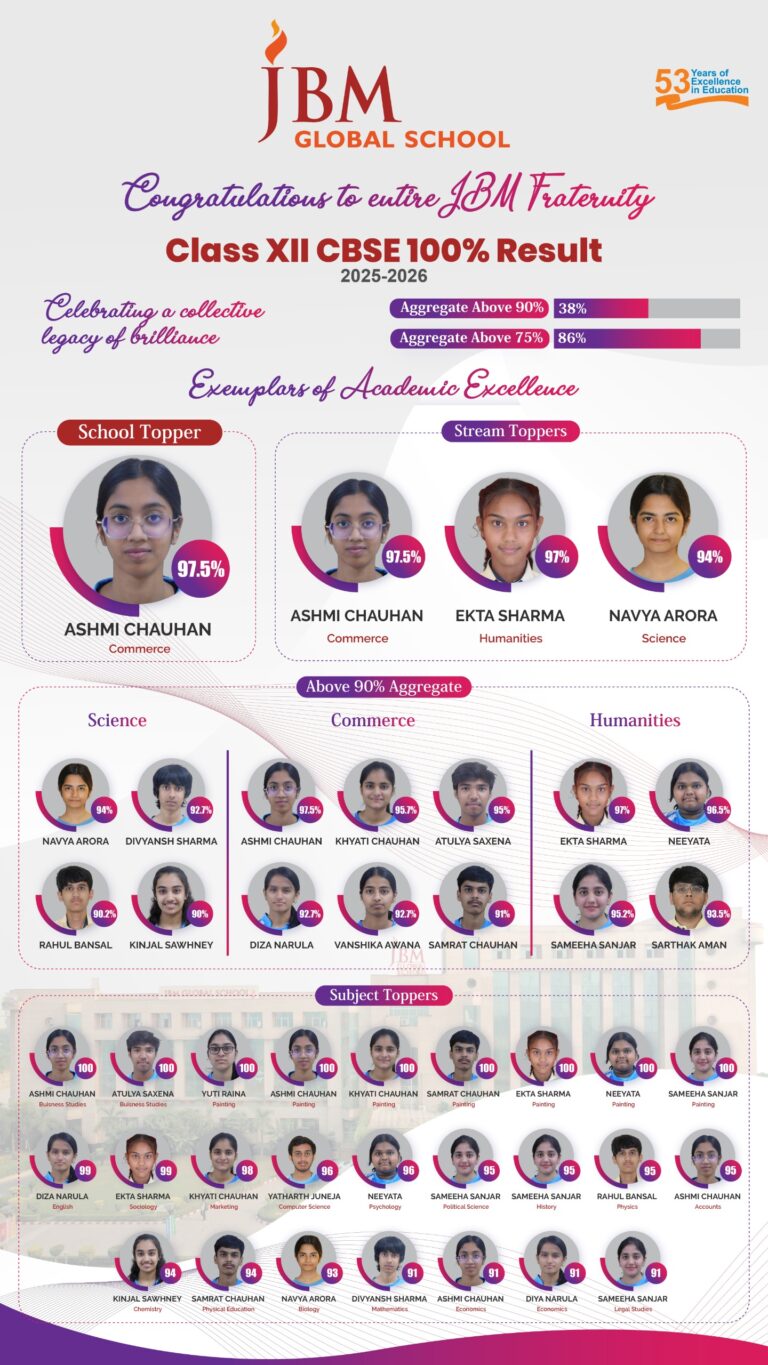
NEP 2020 in CBSE schools is firmly followed by JBM Global School. The learning environment is designed to support the ever-evolving modern education system. The school focuses on:
Students are always encouraged to explore, question, innovate, and grow beyond textbook learning. JBM Global puts equal emphasis on academic achievement and on building confident, capable, and future-ready individuals.
Book a school tour today to see NEP 2020 in action at JBM Global School. Contact us today and discover how future-ready learning, activity-based education, and holistic development come together to shape confident young learners prepared for tomorrow’s world.
Ans: NEP 2020 is India’s new education policy that has transformed the traditional system. It has made learning more practical, flexible, skill-based, and holistic instead of focused only on rote memorisation and marks.
Ans: The 5+3+3+4 structure in NEP 2020 replaces the traditional 10+2 system. It divides education into four developmental stages based on children’s age groups
Ans: NEP 2020 helps students by encouraging creativity, conceptual understanding, skill development, flexibility in subjects, and reduced academic pressure.
Ans: Yes, NEP 2020 in CBSE schools is gradually being implemented. One of the best examples is JBM Global, where children are exposed to competency-based learning, experiential teaching methods, and life skills.
Ans: Absolutely not! Board exams still exist in NEP 2020, but the focus has shifted more towards testing conceptual understanding and application rather than rote memorisation.