Loading....
Close


Technology has massively transformed our world. It has made a permanent place in the way we live, work, and exist, in general. Even some of the careers kids pursue today did not exist a few years ago.
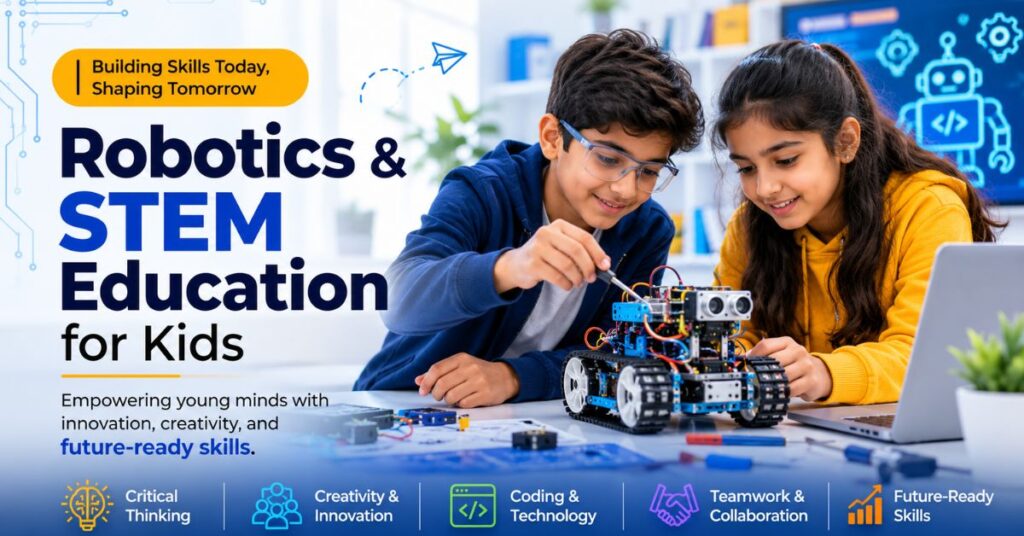
Hence, a traditional classroom and curriculum are no longer enough to prepare them for the current world. Instead, robotics education for kids and STEM learning is becoming increasingly prevalent.
But are they really necessary? Let’s find out the global demand and current utility of robotics education for kids and STEM learning in today’s world with the help of this blog.
STEM basically expands into the subjects of Science, Technology, Engineering, and Math for children. Instead of teaching these subjects individually, STEM education schools in India combine them with hands-on activities and problem-solving projects.
For example, STEM students don’t learn about electricity in a textbook. Instead, they are guided to design and build a working model that uses sensors and motors to generate electricity. While doing so, they naturally apply concepts from Science, Technology, Engineering, and Math for children.
Many schools also extend STEM into STEAM by including the Arts. It encourages creativity along with technical knowledge.
Children have naturally curious minds. Hence, instead of forcing their heads into books, they can be introduced to a robotics program in school.
It encourages them to use the trial-and-error method to ask questions, test ideas, analyse results, improve their designs, and learn effectively in the process. Some of the biggest advantages of robotics education for kids include:
Robotics for school students challenges them to identify problems, evaluate possible solutions, and make informed decisions. This analytical thinking extends to their academics and everyday life.
Abstract mathematical equations and scientific theories become easier to understand when students apply them while building functioning models in their robotics program in school.
There is rarely only a single correct solution in robotics. Hence, innovation skills in students come into play. They are encouraged to experiment, improvise, and improve their existing designs.
A complete working robot gives children a strong sense of achievement. Every successful project, in turn, motivates them to take on more challenging tasks.
Most robotics projects require teamwork. Hence, students eventually learn how to communicate ideas, divide responsibilities, and work towards shared goals.
Programming and coding for kids in India becomes less intimidating when students immediately see the physical results of their code in their moving robots and interactive projects.
Also Read: 21st Century Skills for Students: Essential Future-Ready Skills Every Child Needs
According to changing global trends, there are several growing career roles that are interesting and extremely promising for a flourishing future.
They involve automation, artificial intelligence, robotics, cybersecurity, data science, and advanced engineering. Such workspaces are always on the lookout for innovative skills in students, and more like:
Schools that integrate science, technology, engineering, and math for children throughout their curriculum help them adapt to future technological changes.
Noida continues to grow as a hub for technology, innovation, and global businesses. Hence, parents are also looking for STEM schools in Noida that prepare students for a future driven by science and technology.
Of course, academic excellence is non-negotiable. However, STEM education schools in India should also provide enriching learning experiences that develop creativity, critical thinking, and practical problem-solving.
That’s why many STEM schools in Noida are now integrating robotics for school students and coding for kids in India with the help of innovation labs and experiential learning.
Among these institutions, JBM Global School has taken a structured approach with its Integrated Skill-Based Program (ISBP), which gives every student access to innovation-driven education as part of their regular school experience.
Also Read: How to Build a Growth Mindset in Students for Lifelong Success
STEM schools in Noida have a well-designed robotics curriculum that evolves with a child’s learning journey. That means students are introduced to increasingly challenging activities that match their age, understanding, and problem-solving abilities.
The Integrated Skill-Based Program (ISBP) of JBM Global School follows age-appropriate STEM-based robotics for school students in partnership with Neo Robots.
Students are encouraged to build and explore machines and mechanisms. They develop creativity, teamwork, research-based thinking, and a resilient attitude towards solving challenges in the process.
Moreover, the programme is integrated into regular school hours, which makes it a consistent part of their daily activities.
As the children grow up, the robotics program in school becomes more complex. It enables the understanding of science, technology, engineering, and math in children with practical applications.
All STEM education schools in India may not offer the same quality of robotics for school students. That’s why parents should pay attention to the following aspects of a robotics program in school:
Robotics should be part of a child’s regular learning, and not an occasional workshop. They will develop stronger skills if the application of innovation skills for students becomes a continuous process.
The curriculum should grow progressively from simple concepts in primary grades to advanced engineering and coding for kids in India in senior classes.
Experienced and skilled teachers can help students move beyond assembling kits and understand the scientific and engineering concepts behind every project.
Hands-on learning requires access to robotics kits, programming tools, sensors, electronics, and collaborative workspaces. Hence, a school with well-equipped laboratories must be preferred.
Strong schools encourage participation in exhibitions, innovation festivals, STEM showcases, and robotics competitions for school students.
Also Read: Importance of Sports in School Education: Physical, Mental & Academic Benefits
The Integrated Skill-Based Program (ISBP) at JBM Global is part of their daily curriculum. It exposes students to emerging technologies and practical learning experiences from an early age.
One of the highlights of JBM’s ISBP is its structured robotics programme. It is delivered in collaboration with Neo Robots, which is an organisation known for robotics programmes in schools.
Students work with age-appropriate robotics kits and technologies to understand how mechanical systems, sensors, programming, and engineering principles come together to solve practical problems.
Innovation thrives when students have opportunities to experiment. That’s why students at JBM are always encouraged to ask questions, investigate possibilities, and discover solutions independently.
This reflects the growing importance of maker education in India, where students become creators instead of passive consumers of information.
Experiential learning also helps students understand that failure is a natural part of the innovation process. Every prototype, experiment, and redesign teaches resilience, adaptability, and perseverance.
Classroom learning becomes even more impactful when students can apply their knowledge in competitive environments. Hence, JBM Global encourages school students to participate in robotics competitions, STEM challenges, exhibitions, and innovation events.
It helps students build confidence, develop leadership skills, and gain exposure to emerging technologies beyond the classroom.
At the same time, these experiences often inspire students to pursue higher education and careers in engineering, robotics, computer science, research, and other technology-driven fields.
Also Read: NEP 2020 Explained: How India’s New Education Policy Affects Your Child
The future belongs to learners who can think creatively, solve complex problems, and embrace new technologies with confidence.
Only STEM learning and robotics education for kids can help develop these abilities from an early age and make their learning more engaging, practical, and relevant.
Hence, it is a school’s responsibility to offer an Integrated Skill-Based Program (ISBP), hands-on robotics education, coding initiatives, innovation-driven curriculum, and opportunities to participate in STEM competitions.
It allows students to build the knowledge, confidence, and skills they need to succeed in an ever-changing world.
Discover JBM Global, a top school in Noida, Uttar Pradesh, that combines academic excellence with future-ready learning. Here, students experience science and technology with robotics, coding, innovation, and experiential learning integrated into the curriculum. Contact today for more information!
You May Also Like: Child Anxiety and Exam Stress: How Parents Can Help Their Child Cope
Ans: Robotics for school students and kids teaches them how to design, build, and program robots. At the same time, they learn concepts from science, technology, engineering, and math for children. It develops problem-solving, creativity, logical thinking, and teamwork in them with hands-on projects.
Ans: Many STEM education schools in India introduce robotics with simple building activities and visual coding for kids in India from the primary grades. As students progress, they move on to advanced programming, electronics, automation, and AI concepts during middle and senior school.
Ans: STEM education helps students apply classroom knowledge to real-life situations. It also strengthens their analytical thinking, innovation, collaboration, and digital literacy. These innovation skills for students are increasingly valuable across a wide range of future careers.
Ans: The Integrated Skill-Based Program (ISBP) is JBM Global School’s future-focused learning initiative that integrates robotics, coding, Artificial Intelligence, astronomy, innovation, and experiential learning into the regular curriculum. It basically prepares students for tomorrow’s challenges.
Ans: Yes! JBM Global School encourages students to participate in robotics competitions in school, STEM exhibitions, and innovation events. These give them opportunities to apply their learning, collaborate with peers, and develop confidence with practical experiences.
Ans: A strong robotics programme in school helps children develop critical thinking, creativity, collaboration, coding skills, and confidence while preparing them for technology-driven careers and lifelong learning.