Loading....
Close


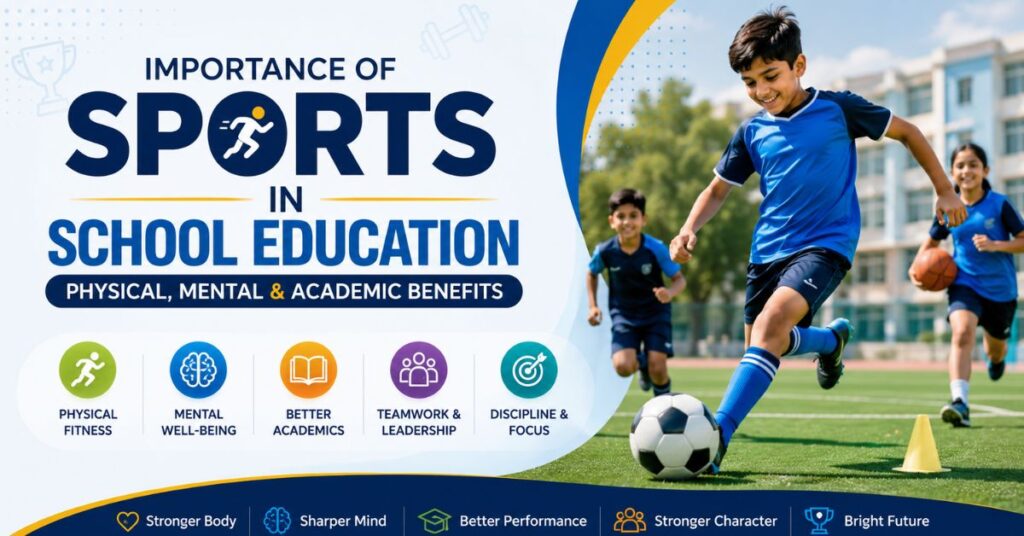
Knowledge from books is never enough for the holistic development of a child. That’s why the importance of sports in school is heavily emphasised. Only a balance between academics and physical education can ensure a steady development of the mind, body, and character of a student.
Moreover, sports activities are not just limited to physical development. They play an impactful role in strengthening mental health, improving academic outcomes, and developing life skills such as teamwork, leadership, resilience, and discipline.
In fact, research shows that students who actively participate in sports often perform better academically, demonstrate greater emotional stability, and develop stronger social connections than their less active peers.
Still not convinced? This blog discusses the importance of sports in school in detail. You can refer to it to ensure your child thrives physically, mentally, and academically.
Despite several benefits, many schools still fail to understand the need for sports education in India. The campuses often have limited school sports facilities, insufficient coaching resources, or a lack of school sports program benefits.
However, the full extent of the benefits of sports for students can only be understood and experienced if every school integrates athletics into their educational philosophy instead of treating them as optional extracurricular activities.
That’s why national initiatives such as Khelo India and increasing awareness around youth fitness have encouraged schools to invest more heavily in sports infrastructure and athletic development.
One of the most obvious yet significant benefits of sports for students is improved physical health.
School sports program benefits lead to stronger muscles and bones, improved cardiovascular health, enhanced flexibility and coordination, excellent motor skills, and a healthy body weight.
Good school sports facilities are prioritised to support overall child fitness in India. It helps students remain energetic and active throughout the day.
A lack of sports education in India can lead to obesity, type 2 diabetes, hypertension, and heart disease later in life. That’s why it’s always recommended to keep your children engaged in physical activities throughout their lives. It reduces the risk of lifestyle diseases and results in a healthier childhood.
Sports such as football, athletics, swimming, basketball, and cricket enhance stamina, endurance, and overall fitness.
According to the World Health Organisation (WHO), children aged 5-17 years old should engage in at least 60 minutes of moderate-to-vigorous physical activity daily. However, many children fall short of this recommendation due to increasing screen time and sedentary lifestyles.
The conversation around sports and student mental health has gained significant attention in recent years.
Students often face increasing academic pressure, social challenges, and digital distractions. But the importance of physical education in providing a healthy outlet for managing these stresses is important.
Physical activity triggers the release of endorphins, which are called “feel-good hormones.” These help to reduce stress, anxiety, and negative emotions.
Sports education in India teaches students that success comes with consistent effort and a steady confidence in their abilities. Hence, every time they score a goal, complete a race, or master a skill, their self-esteem is renewed.
Sports and mental health are closely linked. Regular physical activity teaches students how to handle victories with humility, accept losses gracefully, manage their frustration, and remain calm even under pressure.
Many parents believe that sports distract students from studies. However, research around sports and academic performance shows otherwise.
Physical activity increases blood flow to the brain. This boosts a child’s memory, concentration, information processing speed, and cognitive flexibility. Thus, regular exercise supports the development of neural pathways associated with learning and problem-solving.
When students have fun sports activities to look forward to at school, you will notice a difference in their classroom behaviour. They will often demonstrate regular attendance, active participation, improved focus, and stronger time-management skills.
Many school sports facilities require children to analyse situations quickly, adapt to different strategies, and make rapid decisions. These strengthen their skills of planning, organisation, decision-making, and self-control.
Thus, sports and academic performance benefit every aspect of a child’s growth and development.
Of course, individual sports offer tremendous value. But the benefits of team sports for children are especially significant.
Team sports teach children how to collaborate effectively, share responsibilities, support their fellow team members, and work towards a common goal. These skills remain valuable throughout their life and future careers.
Team sports often provide opportunities for students to lead by example, motivate their teammates, make quick strategic decisions, and resolve conflicts.
Such situations turn them into capable and reliable leaders, which translates into stronger performance in academic and professional settings.
Team sports benefits for children also include building connections with people across diverse backgrounds and age groups.
Students are encouraged to communicate, develop empathy, respect others, and practice inclusivity. Thus, these social competencies contribute significantly to their personal growth.
Also Read: Top 10 Sports For Kids And Their Benefits
One reason experts and teachers continue to emphasise the importance of sports in school is their ability to shape the character and personality of a growing child.
Child fitness in India makes it compulsory for athletes to follow fixed schedules, training plans, and rules. This consistency develops self-discipline and accountability. It has a positive effect on other aspects of their life.
Success is not guaranteed in sports. In fact, you’re more likely to fail. However, such situations teach students the value of practice, patience, hard work, and persistence. They learn that a real winner is someone who doesn’t give up.
Sports education in India teaches children that setbacks are not the end of the world. Instead, they are opportunities to learn and improve, not reasons to quit. This mindset becomes invaluable in academics and future careers.
Also Read: The Role of Education in Skill Development for Success
The most successful schools recognise the extensive school sports program benefits and provide students with diverse athletic opportunities.
The most effective school sports program benefits every child’s unique interests and strengths.
Team sports benefits for children include collaboration, leadership, and communication skills with games like football, basketball, and cricket.
On the other hand, individual sports like athletics, swimming, shooting, and tennis encourage self-discipline, focus, and personal accountability.
Thus, a diverse range of sporting opportunities ensures that more students can participate and discover activities they genuinely enjoy.
The greatest school sports program benefits are achieved when sports become a consistent part of a student’s school life instead of an occasional activity.
That’s why regular training sessions, age-appropriate fitness programs, and access to qualified coaches are highly recommended.
Such comprehensive sports education in India helps students progressively build skills, become disciplined, practice commitment, and develop confidence.
Moreover, sports and academic performance, child fitness in India, as well as sports and student mental health, show a positive influence.
Inter-house, inter-school, district, and state-level competitions provide students with valuable real-world learning experiences.
These events teach students how to handle pressure, set goals, overcome setbacks, and celebrate achievements with humility.
Such experiences contribute significantly to a child’s character development and reinforce the growing importance of physical education in modern education.
Also Read: What is The Importance of Discipline in Students’ Life?
While we’re discussing the importance of sports in school, it is essential to highlight real-world examples of institutions that successfully integrate sports into student development.
JBM Global School has established itself as a leader in providing comprehensive athletic opportunities alongside academic excellence.
At JBM Global School, sports activities are not treated as an occasional extracurricular activity. Instead, they’re considered an essential part of the educational experience.
The school has integrated a structured one-hour daily fitness and sports programme into the timetable for students.
This consistency ensures that physical activity becomes a habit that develops into discipline, stamina, and a lifelong appreciation for fitness.
One of the key strengths of JBM’s approach to sports education in India is the variety of opportunities available for the students.
The school offers access to more than 18 indoor and outdoor sports. This allows children to explore their interests and discover their strengths from an early age.
Students can participate in football, hockey, cricket, basketball, tennis, athletics, volleyball, skating, swimming, yoga, karate, billiards, table tennis, shooting, horse riding, and many more!
Any physical activity they choose supports their physical and personal development.
JBM’s 10-acre campus houses one of the most comprehensive school sports facilities in Noida. It includes traditional facilities such as football grounds, basketball courts, cricket pitches, and an athletics track.
Beyond that, the school also offers specialised infrastructure that includes a horse-riding arena and an exclusive 10-metre shooting range. These facilities expose students to a wider spectrum of sports and various opportunities to pursue competitive excellence in niche disciplines.
Of course, infrastructure alone does not create athletes. That’s why JBM supports student growth with NIS-trained coaches and sports academies focused on disciplines such as cricket, basketball, soccer, shooting, tennis, billiards, karate, and skating.
Once a student’s interests and abilities are identified, specialised coaching refines their skills and teaches perseverance, focus, and goal-setting. This system of mentorship transforms sports participation into a powerful tool for character development and leadership building.
JBM actively encourages its students to test their abilities beyond the school campus. Hence, students regularly participate in CBSE sports clusters, zonal competitions, and inter-school sporting events.
The school also hosts AHAWAN, one of the most prominent inter-school sports events in Noida. It attracts participation from hundreds of schools across Delhi-NCR.
Such exposure helps students develop resilience, sportsmanship, confidence under pressure, and the ability to perform in competitive environments.
JBM’s sports philosophy extends beyond winning trophies. The school’s objective is to develop physically fit, emotionally resilient, socially responsible, and confident individuals.
That’s why the school combines daily sports participation, professional coaching, competitive exposure, and world-class infrastructure.
JBM also ensures that students develop teamwork, leadership, self-discipline, and problem-solving abilities alongside academic excellence. This holistic approach reflects the true importance of sports in school and prepares students for success both inside and outside the classroom.
Also Read: Cambridge International Curriculum vs CBSE: Which is Better for Your Child?
Once you understand and start implementing the importance of sports in school, your child can enjoy the benefits of stronger bodies, healthier minds, better emotional resilience, improved social skills, and enhanced academic capabilities.
Hence, schools must start investing in structured programs, quality coaching, and modern school sports facilities to support student success.
Explore JBM Global School, one of the top schools in Noida that offers world-class sports facilities, including a swimming pool, shooting range, football grounds, cricket facilities, basketball courts, and athletics infrastructure! If you want your child to excel physically, mentally, and academically with a balanced approach to education, contact us today!
Ans: The importance of sports in school lies in their ability to support physical fitness, mental well-being, academic performance, teamwork, leadership, and character development. Thus, sports help students become well-rounded individuals.
Ans: The key benefits of sports for students include improved physical health, stronger self-confidence, better concentration, emotional resilience, teamwork skills, and better academic outcomes.
Ans: Research on sports and academic performance suggests that regular physical activity improves concentration, memory, executive functioning, classroom engagement, and overall learning outcomes.
Ans: Physical education’s importance needs to be acknowledged because it promotes healthy lifestyles, reduces health risks, supports mental well-being, and encourages lifelong fitness habits among students.
Ans: The school sports program benefits offer improved physical fitness, leadership skills, teamwork, discipline, emotional regulation, and increased opportunities for personal growth and achievement.