Loading....
Close


Every parent wants the best possible education for their children. Hence, it’s natural to compare the Cambridge curriculum vs CBSE to understand which will suit their child’s learning style, academic strengths, and long-term goals.
Of course, both are highly rewarding. However, they are designed with different educational philosophies in mind. That’s why their curricula are quite contrasting.
Not to fret because this blog can help you make an informed decision! Discover the key differences between the Cambridge curriculum vs CBSE and which is more suitable for your child.
Before diving into a comparison of Cambridge International vs CBSE India, it’s necessary to understand what the Cambridge Board in India offers.
The Cambridge Board in India falls under the University of Cambridge and is followed by schools in over 160 countries. The curriculum is designed in such a way to develop confident, responsible, reflective, innovative, and engaged learners.
This can be easily achieved by prioritising understanding over memorisation. Students under the Cambridge Board in India are encouraged to understand concepts deeply, ask questions, conduct research, and apply knowledge to real-world situations.
The Cambridge way of learning begins from primary and lower secondary. In these grades, students are guided to build strong foundations in literacy, numeracy, science, and communication.
At the same time, they are encouraged to be curious, think independently, and explore to their full potential. They are also expected to be active learners and develop skills that will contribute to their future academic success.
The IGCSE syllabus (International General Certificate of Secondary Education) is introduced to students aged between 14 and 16 years old. It gives them the liberty to pursue their areas of interest by choosing among a broad range of subjects.
Thus, the IGCSE syllabus allows students to focus more on understanding and application. That’s why parents often prefer Cambridge among Cambridge IGCSE vs CBSE because it’s more academically flexible.
After completing their IGCSE syllabus, students can progress to AS and A levels in India. These qualifications are widely accepted by all the leading universities in the world.
Basically, the AS and A levels in India allow students to specialise in a smaller number of subjects in greater depth.
Thus, if students want to continue to remain in academics, this provides a strong foundation, global recognition, and the flexibility to choose future university programmes and career aspirations.
Also Read: CBSE vs ICSE vs IB: Which Curriculum Is Best for Your Child in Noida?
When we’re considering Cambridge vs CBSE, the latter is a very popular board of education in India. It is widely practised, recognised, and often preferred. Let’s go over its characteristics!
The Central Board of Secondary Education (CBSE) in India is recognised by schools, universities, and government institutions across the country. It follows a nationally accepted curriculum which ensures consistency in syllabus, teaching methods, and academic standards.
The CBSE curriculum follows the guidelines mapped out by NCERT. It focuses on developing strong subject knowledge across core disciplines such as mathematics, science, social studies, and languages.
Such a structured approach leads students to receive a uniform educational experience regardless of their location within India.
The CBSE curriculum is constantly evolving to remain updated and offer a competitive edge to its students. It’s widely preferred for the following reasons:
If we’re discussing Cambridge International vs CBSE India, many students benefit from the latter.
If you’re planning to pursue higher education in India and sit for competitive examinations such as JEE, NEET, CUET, and various government entrance tests, CBSE can be very helpful.
It’s so well-structured that students are automatically equipped to perform exceptionally well within clearly defined academic frameworks.
Also Read: CBSE vs State Board Schools in India: Key Differences and Which One is Better for Your Child
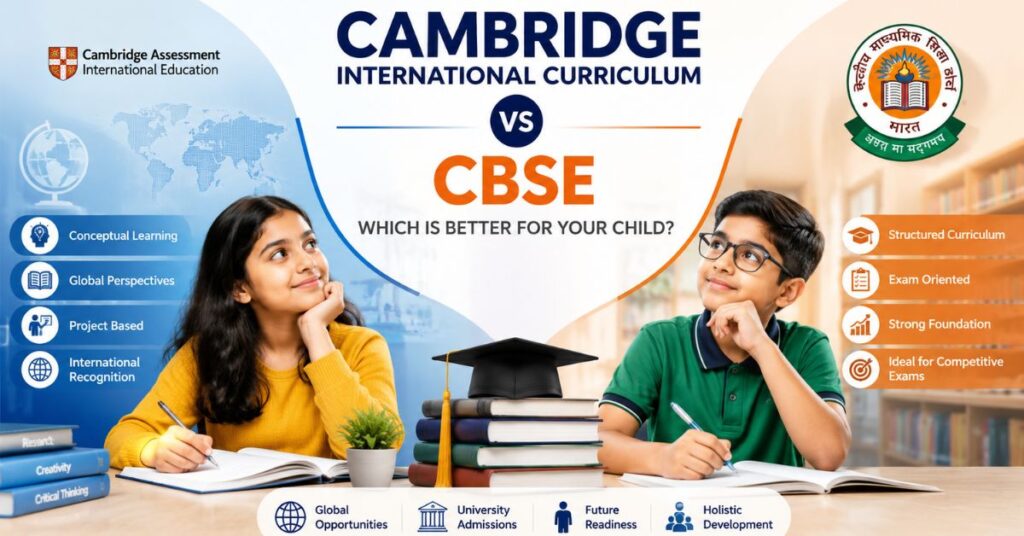
The answer to Cambridge vs CBSE, which is better, completely depends on your child’s learning style and future aspirations. The comparison table of the Cambridge curriculum vs CBSE may assist in making your decision easier:
|
Aspect |
Cambridge International |
CBSE |
| Curriculum Focus | Conceptual understanding and inquiry-based learning | Structured academic learning |
| Learning Approach | Student-centred | Teacher-guided |
| Assessment Style | Projects, coursework, practicals, exams | Primarily examination-based |
| Subject Flexibility | Extensive subject choices | Standardised curriculum |
| Global Recognition | High international acceptance | Strong national recognition |
| Competitive Exam Prep | Moderate | Strong |
| Skill Development | Critical thinking, creativity, and communication | Academic discipline and subject mastery |
| University Options | Excellent for international admissions | Excellent for Indian admissions |
Also Read: How to Choose the Right School for Your Child: A Parent’s Guide
You can consider Cambridge over CBSE if your child:
On the other hand, CBSE is your best bet if your child:
Thus, between Cambridge International and CBSE India, the best curriculum is the one that allows your child to learn confidently, grow holistically, and achieve their full potential.
Also Read: CBSE School Admission Process in Noida 2026-27: Complete Guide for Parents
The popularity of the Cambridge Board in India pathway has increased significantly in recent years. That’s because parents are now becoming more aware of international educational opportunities, and, hence, the demand for Cambridge schools in Noida continues to grow.
Also Read: List of Best Schools in Noida for Admissions
Since most parents face the dilemma of choosing between the Cambridge curriculum and the CBSE, JBM Global solves this problem by offering a combination of both.
Their dual-curriculum advantage allows parents to ensure the best educational experience for their child’s strengths, interests, and future aspirations. The school guarantees a strong academic foundation and the appropriate guidance needed for success.
Thus, the debate around the Cambridge curriculum vs CBSE will not conclude with a single winner. That’s because the former provides globally recognised qualifications, flexible subject choices, and numerous international curriculum benefits.
On the other hand, the latter offers academic rigour, affordability, and consistency and prepares students according to India’s higher education and competitive examination ecosystem.
Ultimately, the right choice depends on your child’s learning style, future aspirations, and educational needs.
Explore JBM’s Cambridge & CBSE Dual Curriculum and discover how a future-focused education can help your child thrive in an ever-changing world. Contact today!
Ans: Cambridge focuses on conceptual understanding, inquiry-based learning, and global perspectives. On the other hand, CBSE follows a structured curriculum that supports Indian academic and competitive examination requirements.
Ans: Yes, of course! The Cambridge Board in India is recognised by educational institutions and universities across India as well as internationally.
Ans: The comparison between Cambridge IGCSE vs CBSE actually depends on a student’s learning style. Cambridge emphasises analytical thinking and application, while CBSE focuses on comprehensive subject mastery and examination performance.
Ans: Yes, absolutely! Many Indian universities accept AS and A Levels in India. However, the admission criteria may differ between institutions.
Ans: Some major international curriculum benefits include critical thinking, communication skills, global awareness, flexibility in subject selection, and strong preparation for international higher education.
Ans: CBSE is generally considered much better for JEE and NEET because these examinations are closely linked to NCERT-based content.
Ans: A dual-curriculum school like JBM Global School provides flexibility and allows families to choose the academic pathway that best supports their child’s strengths, goals, and future educational plans.